
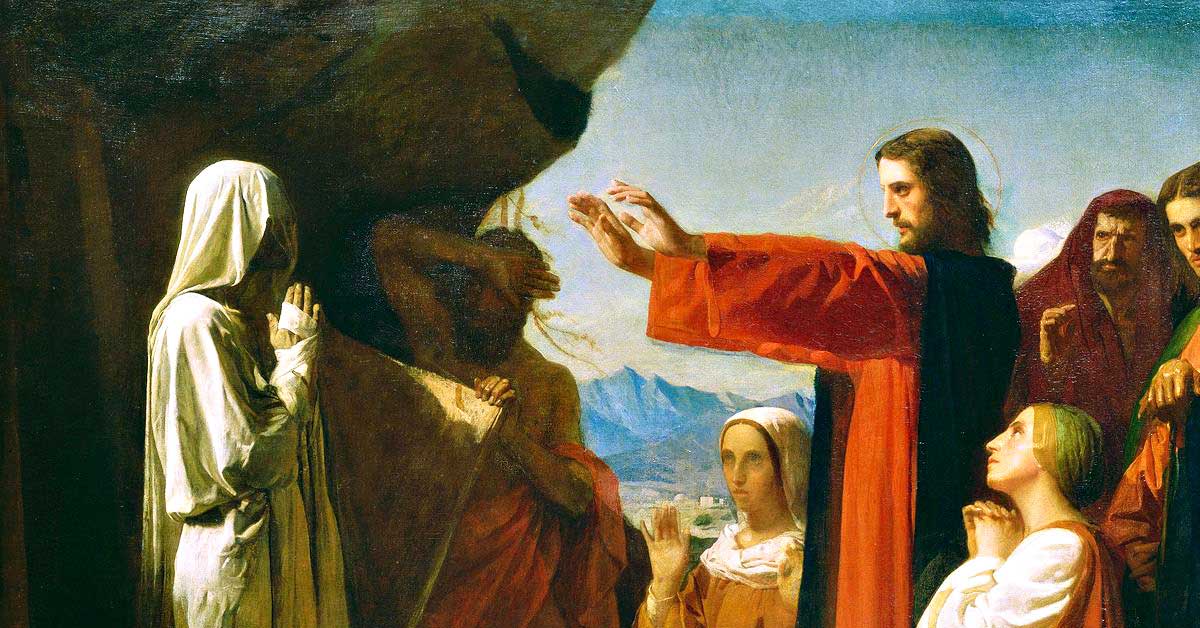
What a beautiful and moving story, this account of the raising of Lazarus!
However, I want to limit myself to just three aspects of the story, to three elements, taken from the beginning, the middle, and the end of the Gospel account, respectively.
Let us begin with Our Lord’s reluctance to go to Bethany when he hears the news that Lazarus is sick. We are told that though Jesus loved Martha and her sister and Lazarus, after having heard that Lazarus was ill, he stayed two days longer in the place where he was. Both the sisters, both Martha and Mary, reproach him for this. Both say: ‘Lord, if you had been here, my brother would not have died.’ So why does Jesus do this? Why does he not go immediately? Jesus’s own answer, his explanation, is that it is for God’s glory, so that the Son of God may be glorified through it.’ But somehow this doesn’t convince: at worst, it smacks more of manipulation than compassion. However, it is an element in the story that points to a wider and very important truth about God; ‘God’s delays are not God’s denials.’
At yesterday’s book fair I was talking to a young woman, not quite a teenager, who was an avid reader: she was saying that she had just read all of the Harry Potter books. Well, after J. K. Rowling wrote the first book, Harry Potter and the Philosopher’s Stone, her manuscript was rejected by 12 publishers. At the time, J. K. Rowling was a single mother in Edinburgh, living on welfare, and writing in cafés. Finally, a small publisher, Bloomsbury, took a chance—partly because the chairman’s daughter came across the manuscript on her father’s desk and loved the first chapter. The outcome, as you know, was a global phenomenon, the creation of one of the best-selling book series in history. ‘God’s delays are not God’s denials.’
Many of stories of the patriarchs in the Old Testament also illustrate this truth: for example, Sarah, Abraham’s wife, waiting well into old age before she conceives a child; Jacob, who falls in love with Rachel, and has to work for seven years before Laban who then tricks Jacob into marrying his other daughter, Leah, so that he has to work another seven years before he can finally marry the girl of his dreams. Or there’s the way God makes the people of Israel wait for forty years in the wilderness until they could finally enter the Promised Land.
But to come back to the story of Christ’s raising of Lazarus, and – as I said I want to take something from the middle of the story. And it is this: When Jesus saw [Mary] weeping, and the Jews who came with her also weeping, he was greatly disturbed in spirit and deeply moved. Next we have what is famously the shortest verse in the Bible: Jesus wept. We see how moved Jesus is for the death of his friend, and by the grieving of Lazarus’s family and friends. And yet, from the very beginning Jesus knows how this incident is going to end, for hasn’t he already said to the disciples, ‘This illness does not lead to death; rather it is for God’s glory, so that the Son of God may be glorified through it.’? We see how Christ’s grief for the tragedies in life exists side-by-side with his knowledge that Lazarus’s death is not the end of the story. And somehow, for Christians, we live with the same paradox: we experience death as a heart-wrenching loss, even while we can say ‘we believe in the resurrection of the dead’.
And so we come to the end of this extraordinary story. Lazarus emerges from the tomb, still bound in the trappings of death—his hands and feet wrapped in strips of cloth, his face covered. Jesus does not simply raise him; He turns to the crowd and says, “Unbind him, and let him go.” This is not just a command to remove physical grave clothes; it is an invitation to participate in the work of liberation.
God’s delays are not God’s denials, as we’ve seen. But neither is God’s work ever done in isolation. Jesus could have removed the cloths Himself, but He didn’t. He called the community to act. This is a profound reminder that our faith is not passive. We are called to be the hands and feet of Christ, to unbind one another from whatever holds us captive—whether it’s grief, fear, injustice, or the weight of our own past.
Think of the young woman at the book fair, the patriarchs of old, or even our own stories of waiting and wondering. God’s timing may not be ours, but it is perfect; moreover, His work is often done through us. Lazarus needed the community to step forward and remove the cloths so that he could truly live again. In the same way, we are called to help unbind those around us—whether it’s through a kind word, a helping hand, or standing against the systems that keep people trapped in darkness.
The raising of Lazarus is not just about a miracle; it’s about what comes after. It’s about a community that responds to Christ’s command to set one another free. So let us ask ourselves: Who in our lives needs to be unbound? Who needs to hear the good news that death does not have the final word? And how can we, like those first witnesses, step forward in faith and obedience to help them walk into the light?
Let us pray for the courage to be part of God’s liberating work, to unbind one another, and to live as people who believe in the resurrection.