
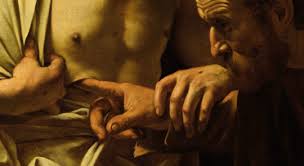
Shortly before Easter someone, who has been a regular church-goer all their life, told me that they didn’t believe in the resurrection; the reason they gave was that they were too rational. I’ve been turning this over in my mind ever since then, and as we read today’s Gospel story of ‘doubting Thomas’ I want to share with you, as best I can, my response to this person.
The first thing I want to say is that even though belief in the resurrection is foundational to the Christian life, and might be seen as the entrance ticket to church membership, it is quite alright to have one’s doubts. After all, the New Testament characters who were witnesses to the Easter event all started in a place of doubt before they came to believe in Jesus’s ‘getting up’ from among the dead. The women who discovered the empty tomb fled from it in terror and amazement, according to Mark’s gospel; in John’s gospel Mary Magdalene stood weeping, thinking only that her Rabbi’s body had been taken away; and Peter and John too ran disbelieving, to find the tomb empty.
Christianity is both a story and a journey, and I think it is essential that we are honest with ourselves about where we are on that journey, and who we identify with in the story. Do you identify with Thomas when he says ‘Unless I … put my finger in the mark of the nails and my hand in his side, I will not believe.’? That’s OK, as long as you are in the company of those who say ‘We have seen the Lord’. And that they really have, of course!
The second thing I want to say are two related insights that derive from being an Anglican: our church is a national church, not a confessional church. In other words, it is a church that opens its doors to anyone and invites them to worship together before they sign up to a particular set of beliefs; that doesn’t mean we have no doctrine, no core beliefs – of course we do! But it does mean that we value fellowship and tolerance of divergent views over doctrinal unity. Let people come to church to enjoy our liturgy, the reading of scripture, our music, the ancient buildings – whatever! But let people come to church first and then find out where we stand.
The other central Anglican insight derives from Jeremy Hooker’s famous image of the three-legged stool. If Thomas Cranmer gave us our liturgy, and the wonderful words of the Book of Common Prayer, it was another Elizabethan, Jeremy Hooker, who was the first Anglican theologian: among the most significant things he said was that our faith rests on the three legs of Scripture, Tradition, and Reason. So when someone tells me that our foundational belief – in the resurrection – is not rational, we, as Anglicans, need to listen very closely.
But note this: the Resurrection cannot be dismissed as ‘unscientific’, that’s just lazy thinking. Science can only observe what happens, it cannot dictate what should happen. Science is a process of observation and hypothesis, carried on in conditions of controlled experimentation: there were no trained observers, no repeated experiments, in Jerusalem on, and after, Easter Sunday. Science can tell us a lot about the physical universe, and how it functions, yet it is not the instrument for establishing the truth of a one-off historical event. We do not appeal to Science, for example, to tell us whether Napoleon or the Duke of Wellington won the Battle of Waterloo.
The kind of reasoning, then, which we need to bring to the resurrection is an examination of the historical evidence. This, by the way, is considerable: we know more about Jesus than about anyone else who lived during the Roman Empire – including the Caesars.
There are five ways of explaining the Resurrection account: 1) the early church made it up; 2) the disciples were suffering from some kind of mass delusion; or 3) they got together and decided that despite coming to such an ignominious end, the spirit of Jesus lived on. 4) is that Jesus never actually died on the Cross, and 5) is that something like the Resurrection as it is portrayed in the New Testament did actually occur.
For my money, the first three explanations are totally unconvincing: I cannot believe that after the death of their Master the gaggle of scattered, fearful, and ashamed disciples would have got together over that first weekend and concocted such a story. Such an idea defies logic, it goes against human nature, and if they had made it up, they would have come up with a more convincing story: certainly, for example, they wouldn’t have come up with the idea of women being the first witnesses to the resurrection, and they would have tidied many of the loose ends and discrepancies that the New Testament accounts contain. Then, the idea that Jesus didn’t really die, but was put into the tomb in a coma, makes no sense either: first, the Roman soldiers would have been well able to recognise a still-living body when they saw one – after all, they were well-practised in the grisly art of crucifixion. We are told they found him dead, and that that’s why they pierced his side, just to make sure. Moreover, the calm, radiant figure who appeared to his followers hardly looks like a tortured and crucified figure who has lain on a cold slab for 36 hours with no medical attention.
That leaves us with the last explanation: that something akin to the gospel accounts of the Resurrection actually took place. Personally, I don’t think you can explain the appearance of the early church without it. Peter and the other apostles would never have boldly stood up before Jerusalem’s highest religious authorities to proclaim that the God of their ancestors had raised up Jesus had they not been 100% convinced.
That Christ ‘stood up from among the dead’ was no more believable 2,000 years ago than it is today; humanity hasn’t ‘wised up’ in the meantime. What we still have is the good news of Jesus’s resurrection told in four different gospel testimonies; what we have always had is the witness of the church stretching back over 2,000 years – not just the tradition of institutional witness, but the stories of the millions upon millions of women and men in each generation personally witnessing to the power of faith; and what we will always have is the rationality of the historical evidence forever leaving the door ajar. Science can no more slam that door shut than the Church’s collective witness can thrust it open. It is up to each one of us, in the solitude of our hearts, to decide whether to slip through that half-open door on our own – and whether we are going to listen to the voice that beckons from the other side.