
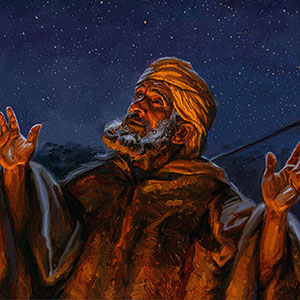
We’ve heard a lot about Abraham in our readings this morning. We heard the beginning of his story in the reading from Genesis ch.12, and in his Epistle to the Romans, Paul has much to say about Abraham’s faith.
So what do we know about Abraham – or, as he is known at the beginning of the story, Abram? To begin with, he was the first of the patriarchs, he was the father of the nation of Israel, and he was the first ancestor of the Jewish people to come to the Holy Land. He was also the first monotheist; the first person to worship One God. Abraham was, as we have just heard, the first person to obey that God, and to whom the One God made promises – quite outlandish, incredible promises when you think about it: promising to give him a son when he was in advanced old age and when Sara his wife was already beyond the age of child-bearing. And there are other things we know about Abraham: he wasn’t afraid to stand up to God, interceding for the cities of Sodom and Gomorrah. On the negative side, and when left to his own devices, Abraham was not always the righteous man he is remembered as: on two occasions he passed his wife Sara off as his sister to avoid conflict, and in an act of cowardice; and quite frankly his treatment of the slave girl Hagar – packing her off into the wilderness with their son Ishmael – was a disgrace. Indeed, if you look at the family life of any of the patriarchs, the most well-disposed reader can only marvel at how disfunctional all those families were… Finally, to complete this potted biography of Abraham, we must include the incident when Abraham takes his son Isaac to Mount Moriah, prepared to sacrifice him there. At the very last moment God intervenes…
However, for our purposes, and for Paul’s, two facts about Abraham stand out: the two F words. Abraham is the first person in the Bible to be described as a friend of God’s; and, as Paul insists on telling us, Abraham was a man of faith.
Abraham went further than magnifying the existence of the One God; he even went further than obeying Him. Over the decades Abraham learned to recognise God’s voice, and he learned to relate to God with the kind of give-and-take that only close friends share. Friendship is an easy enough concept to grasp: it involves enjoying someone else’s company, spending a lot of time together, and doing things together. Extending the idea to God, and saying that Abraham was a friend of God – well, it’s a lovely image, and tells us a lot about the kind of man that Abraham really was.
But what about ‘faith’? When Paul says that Abraham had ‘the righteousness of faith’, what exactly does he mean? I think that in the epistle to the Romans, Paul implies three things about faith – but before we talk about what they are, here are some of the things that people say about ‘faith’ that aren’t particularly helpful: ‘faith’ is not agreeing with a set of doctrinal propositions; nor does it involve being baptised and being a regular church goer / those are just its outward signs; and nor is it just about having our religious emotions stirred up.
The first thing that Paul says about faith, is that it is different from the law. In other words it is not about what we do; rather, it is an attitude, a willingness to let go and receive from God. Indeed, the Christian life often only begins after we have come to the end of ourselves and of our own resources; it begins when we get a glimpse of the possibility of standing on other ground than that of who we think we are, and of the life we have built for ourselves. It begins with a glimpse of standing on Holy Ground, on rock rather than sand. And it is precisely because they knew themselves to be hopelessly compromised, to have gone completely off the rails, that Jesus found the sinners and the publicans, the fallen-women and tax-gathers – people like Matthew in the today’s gospel reading – far more amenable to his message than the self-righteous, law-keeping Pharisees. Secondly, faith has power not in itself, but because of the one in whom we place our faith. It’s no good having faith in the supernatural or believing in the irrational – even faith in angels or crystals or positive thinking isn’t enough – we need faith in the covenental God of the Bible and in his Son, Jesus the Messiah. And thirdly, to have faith is the ability to keep on believing, day after day, that ultimate reality isn’t the world we see around us, but instead it is what we cannot see – the spiritual realm. Paul calls it, especially in his letter to the Ephesians, where he deals with the subject in depth, ‘the heavenly realms’. Like Abraham, therefore, we need to hope against hope, trusting in God and his promises, even when the evidence goes against it. Notice though, that Abraham’s faith wasn’t blind, wasn’t just a leap in the dark – it was based on the word that God had spoken to him.
Maybe, just maybe, if we cultivate a friendship with God, we too will hear God’s promises for our own life. What I am sure of, though, is that our faith needs to be based in the solid soil of God’s written word in Scripture, and in the living word, Jesus Christ himself. Quite probably, none of us here this morning suffers from the desperate need, nor are we in such proximity to Jesus, as was the woman who had been suffering from haemorrhages for twelve years: yet Jesus is in accord with Paul when he says ‘Take heart, daughter – your faith has made you well’.