Allow me to read the second half of our gospel again: “Jesus said to them, ‘The light is with you for a little longer. Walk while you have the light, so that the darkness may not overtake you. If you walk in the darkness, you do not know where you are going. While you have the light, believe in the light, so that you may become children of light.’”.
I ask myself if the darkness overtaking us isn’t an apt description of the process of division that has overtaken the churches: the great schism, the clefting of the Western church at the time of the Reformation, and the splintering of Protestant churches into a myriad denominations. Doesn’t this seem, in retrospect, as though we have been walk in the dark? The often bitter disputes between the churches are rather like one of those families where our great-great-grandparents fell out. And when their great-great-grandchildren gather around the table today, there are some who insist on keeping the old family feud aflame, whereas most of the sensible ones say, “Look, that all happened years ago, centuries ago. Let’s move on.”
And we have moved on. Even in my own lifetime, I remember when, as a child, one would no more go into the church of another denomination than one would go to a Hindu temple or Mosque. Each unknown denomination was a foreign country, perhaps even a hostile country. And thank heavens, the climate, the ecumenical climate has changed. Not only has there been an institutional opening, a willingness to dialogue in the decades since WW2, but there has been a great deal of fellowship and shared initiatives from the parish level up that have led to much greater trust and fraternity between the churches. However, given that I am not qualified to speak of the institutional ecumenism, I would like to share with you some very personal glimpses of ecumenism in my own faith journey.
At the age of 12, after conversation with a Christian friend at school, I decided to go to church in the local village, my own parents being resolutely secular in outlook. And as I walked the 2 miles 3 kilometers into the local village, I came to a gate: to the left stood the Church of England parish church and to the right, the Roman Catholic convent. And for a moment, at least in my imagination, because this is more than half a century ago, I paused undecided whether to turn left or right. I chose the parish church of my school faith rather than the Roman Catholic chapel, where I had been at least once before for a wedding.
Ten years later, I stopped going to church altogether, but that’s another story. And I found my way back to faith at the age of 50; and although I willingly returned to the Anglicanism with its wonderful hymns and familiar services and found it emotionally deeply satisfying, I was also very conscious that I was first and foremost a Christian and only an Anglican by chance. And since then, I’ve always considered it healthy to keep windows open towards all the denominations.
In the Anglo-Saxon world, unlike here in Italy, we are surrounded by many churches of many denominations and if we don’t like one, it’s a very common practice to go and try another one. Indeed, during the decades of my apostasy, for a year or two at least, I began to attend the Quaker services, because I didn’t feel I was able to say the creeds. The Quakers, you may know, meet together for an hour on Sunday mornings and sit in silence.
Let me tell you another, more personal story. When I was leaving home for my ordination, my mother-in-law, Lorenza, – who by the way will turn 96 this summer – took the wooden rosary that she had been using for half her life out of her pocket and gave it to me. I was very touched by that, as I’m sure you can imagine. So I resolved to actually start using it: to learn to pray with these beads which represented a tradition that was so not my own. For the next six months the Marian rosary become my daily rule of prayer. And what I learned was what no doubt any catholic can tell you: the rosary isn’t really about Mary, but about Jesus: moreover recalling and praying through the twenty ‘mysteries’ of the rosary is an excellent way of meditating on the key points of the Gospel story on a regular basis. It really grounds a synthesis of the gospel story in one’s thoughts, and in the thoughts of one’s heart.
My last memory – though I do hope I am not boring you with these personal recollections – comes from the summer after I’d been ordained a priest. I was serving at our Church on Lake Como; and it was a year when Ferragosto coincided with a Sunday. I had a dilemma. The Sunday congregation consisted largely of tourists, so I had no idea who would be walking through the doors of the church that Sunday, neither which nation the congregation would be coming from, nor whether they were of a Catholic or a Protestant background; we only knew that these were people were coming to an English-speaking church because they didn’t speak Italian. How then was I to preach on the Feast of the Blessed Virgin Mary to a congregation that may be Protestant or may be Catholic and was probably a mixture of both?
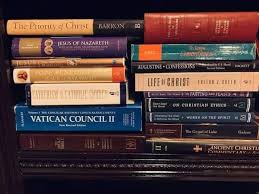
Well, I’m going to conclude my words to you today the way I concluded that sermon then: by inviting you, whatever your faith background – your churchly comfort zone – to attend a church service, or at least to read a book, which belongs to a different tradition from your own. With regard to books, I have taken the liberty of drawing up some suggestions (see below) – all titles of books from different faith traditions, and all, I believe, available in Italian.
Ecumenism is the great calling to the church in our age. What more can we do than become acquainted with our estranged brothers and sisters, those distant cousins who perhaps we hardly know of except by rumour. For hasn’t the Lord promised to draw all people to himself? And while we attempt to walk in His light and towards His light, may that Light enable to make out the features of our estranged brothers and sisters whom he has also called! Amen.
1. The Pilgrim’s Progress John Bunyan
The obvious starting point. This seventeenth-century allegory has shaped Protestant imagination almost as much as any work outside the Bible itself. It introduces themes of conversion, grace, perseverance, and the Christian life as a journey. Tradition: Evangelical / Baptist
2. The Freedom of a Christian Martin Luther
A short but profound introduction to the heart of Lutheran theology: justification by faith, Christian freedom, and the relationship between faith and good works. Tradition: Lutheran
3. Institutes of the Christian Religion (selections) John Calvin
The complete work is enormous, but many Italian editions offer selections. Calvin provides a clear window into Reformed theology and Protestant approaches to Scripture, grace, and the Christian life. Tradition: Reformed
4. A Plain Account of Christian Perfection / The Holiness of Heart and Life John Wesley Any good collection of Wesley’s sermons or writings on holiness is worthwhile. Wesley’s emphasis on conversion, sanctification, and practical discipleship remains influential across Protestantism. Tradition: Methodist / Anglican
5. Thoughts Dietrich Bonhoeffer Bonhoeffer is widely admired by Catholics and Protestants alike. His devotional and spiritual writings reveal a deeply Christ-centred Protestant spirituality. Tradition: Lutheran
6. The Cost of Discipleship Dietrich Bonhoeffer
Perhaps the twentieth century’s most powerful Protestant reflection on discipleship. Bonhoeffer’s critique of “cheap grace” resonates strongly with Catholic concerns about authentic Christian living. Tradition: Lutheran
7. Mere Christianity C. S. Lewis
Lewis writes from an Anglican perspective but deliberately focuses on “mere” Christianity. This is often the easiest and most attractive introduction to Protestant thought for Catholic readers. Tradition: Anglican
8. The Screwtape Letters C. S. Lewis
A witty and profound exploration of temptation, spiritual warfare, prayer, and discipleship. It conveys Anglican spirituality in a memorable form. Tradition: Anglican
9. Knowing God J. I. Packer
One of the great modern evangelical classics. Deeply theological yet devotional, it demonstrates the evangelical emphasis on a personal relationship with God grounded in Scripture. Tradition: Anglican Evangelical
10. Celebration of Discipline Richard Foster
An excellent introduction to Protestant spirituality, covering prayer, fasting, meditation, study, simplicity, and service. Catholics often find it surprisingly familiar. Tradition: Quaker / broadly Protestant
11. Surprised by Hope N. T. Wright
A contemporary Anglican treatment of resurrection, heaven, and the renewal of creation. Wright is one of the most influential Protestant theologians of recent decades. Tradition: Anglican
12. Good Morning, Holy Spirit Benny Hinn
While not representative of all Pentecostalism, this very influential book introduces the experiential spirituality and emphasis on the Holy Spirit that characterize much of the Pentecostal world. Tradition: Pentecostal / Charismatic