In both the epistle and the gospel this morning we have heard perhaps the most talked about passages in Paul’s Letter to the Romans and in St Matthew’s gospel, respectively. Both readings represent a turning point: in the letter to the Romans, there’s a turning point in that after eleven chapters of Paul’s densest and most theological writing he now switches his attention to practical, every day affairs for the remaining five chapters; and in Matthew’s Gospel the disciple Peter finally comes out and declares his belief that Jesus is the Messiah, the son of God.
In today’s reading from Romans, we have those beautiful words, familiar from the post communion prayer, about presenting our souls and bodies as a living sacrifice. Now there’s an oxymoron if ever there was one, there’s a paradox: a living sacrifice. In the ancient world, animal sacrifice was the whole point of religion – it was all about killing animals, and in some cases people, to appease the gods. But now that Christ has offered himself as the one final, perfect, and acceptable sacrifice, what’s left for us is to be an ongoing sacrifice of service and praise. Moreover, God demands not only our activity, our bodies, but above all our inner orientation, our hearts and souls.
The real turning point that St Paul emphasizes again and again, is that with the Crucifixion the whole system of animal sacrifice has come to an end – it has been replaced by Christ’s one perfect and final sacrifice. It isn’t really until the curtain temple is split in half at the crucifixion, making a way through to the Holy of Holies, that the terror of God is once again replaced by intimacy: and it takes St Paul to spell out all of the joyful and grace-filled implications of this.
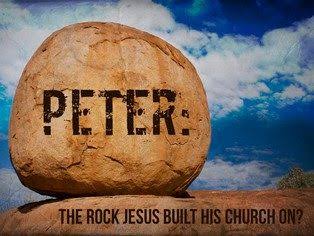
Turning to today’s gospel, Jesus’s asks the disciples first, what are people saying about me, then, to them specifically, ‘Who do you say I am?’, to which Peter answers with the confession that Jesus is the Messiah, the Son of the Living God. That leads to Christ’s notorious response that ‘you are Peter, and on this rock I will build my church’. Well, here indeed is a rock that has become a stumbling block! But only since the Reformation: Western Christianity appears to have been split down the middle by the interpretation of these words, not least because of the way that they have been used to legitimise the papacy. However, that is not a road I wish to go down: Christians in the West are already enough of an endangered species, that rekindling squabbles from the past is to no-one’s advantage.
However, what I would like to underline is how ambiguous this phrase is, and how many different interpretations it allows for: St John Chrysostom preached that Jesus’ word to Peter – “and on this very rock I will build my church” – means that Jesus will build his church ‘on the faith of – or the faith underlying – Peter’s confession’. This was the ancient view attested by many of the Church Fathers.
Before spelling out some of the different interpretations; let’s begin with a paraphrase: “Simon, you’re a brick, and with this brick I shall build my church” – that captures the pun, and maybe catches some of the twinkle in Jesus’s eye as he uttered those words. (If, that is, you can allow your Jesus to have a sense of humour.)
Here goes for the interpretations: 1) Peter, on your confession that I am the Messiah I shall build my church; 2) on you personally I shall build my church; 3) on the faith of anyone who confesses me as the messiah I shall build my church; and 4) on you and on your successors in Rome I shall build my church. I must say I find the first two far more convincing than the last two, although the latter pair might be taken as the classic Protestant and Roman Catholic positions respectively.
‘On you personally’ is good: it’s accurate. Peter was really made into somebody and something by Jesus: as we read through the book of Acts, we see that it was Peter who opened the gates of the kingdom to the Jews on the day of Pentecost in Acts chapter 2, and to the Gentiles through Cornelius in Acts chapter 10; and in between it was Peter, with John, who opened the doors of the kingdom to the “in-between” people, the Samaritans at the Samaritan Pentecost in Acts chapter 8.
My last note, however, is that the real turning point is less about how Peter speaks up for the disciples in confessing that Jesus is the Messiah, the Christ (both words mean ‘the anointed one’, in Hebrew and in Greek respectively): it’s that from now on Jesus is going to demonstrate what kind of Messiah he is, the kind of Christ we are called to follow – and he is not at all the expected triumphant king, but a man of sorrows, one destined for the gallows. This is going to be a hard lesson for the disciples to learn, as it is for us – that Christ reigns from and through the Cross.