
“In England they have good table manners; on the Continent we have good food.” Thus wrote the Hungarian humorist George Mikes, seventy years ago. When she was little, my daughter learnt a lot about English table manners. Every year, before her annual visit to her English grandparents, she received weeks of rigorous training in how to behave at their table: the correct way to hold a knife and fork; she must never put her hands on the table; and above all — the most difficult lesson — on no account was she to dunk her biscuits in her tea or milk at breakfast time. And so, much as she enjoyed her summers in England, I am sure the run-up to the holiday was tinged with apprehension.
As we reflect on this morning’s parable, the promise of the Kingdom of Heaven contains a similar mixture of fear and anticipation. On the one hand, what a delight to be invited to the king’s wedding feast: the oxen and fat calves are ready and waiting. On the other, dire threats hang over those who refuse the invitation, and over the poor guest who fails to dress for the occasion. Fear and anticipation, side by side. Which of them is Jesus actually leaving us with? That is this morning’s question.
Luke, in chapter 14 of his gospel, tells almost the same story — but with the fire taken out: no king, no burning city, no outer darkness. When the guests make excuses, the householder simply sends his servant out to fill the house with the poor, the blind, the disabled, the hurting, the lonely. Matthew won’t let us off so lightly. He gives us a king, a burned city, a guest thrown into the darkness, and a chilling final line: “many are called, but few are chosen.” Matthew means to unsettle us — so let’s not rush past the unsettling parts.
The guests do something almost unthinkable: they refuse. Some go off to farm or business, as though a king’s wedding were an inconvenience in the diary; others seize the servants and kill them. The invitation of the Gospel is not one option among many: it claims to reorder the whole calendar, and a life can be lost — genuinely lost — simply by keeping the feast perpetually on hold. The outer darkness, I suspect, is less a punishment God delights to inflict than a description of a life that has said “no” — or “not yet” — one time too many.
But notice what the king does with his rage: he does not cancel the feast, nor sit sulking over the wasted oxen. He sends the servants out again — into the streets and lanes, to gather “all whom they found, both bad and good.” Both bad and good; Matthew refuses to sort them. The banquet is filled not by the well-mannered but by the found. And that is the only reason any of us is sitting here this morning. Nobody in this church — in this whole worldwide communion — earned the invitation by passing a manners examination. We were found in the street and brought in.
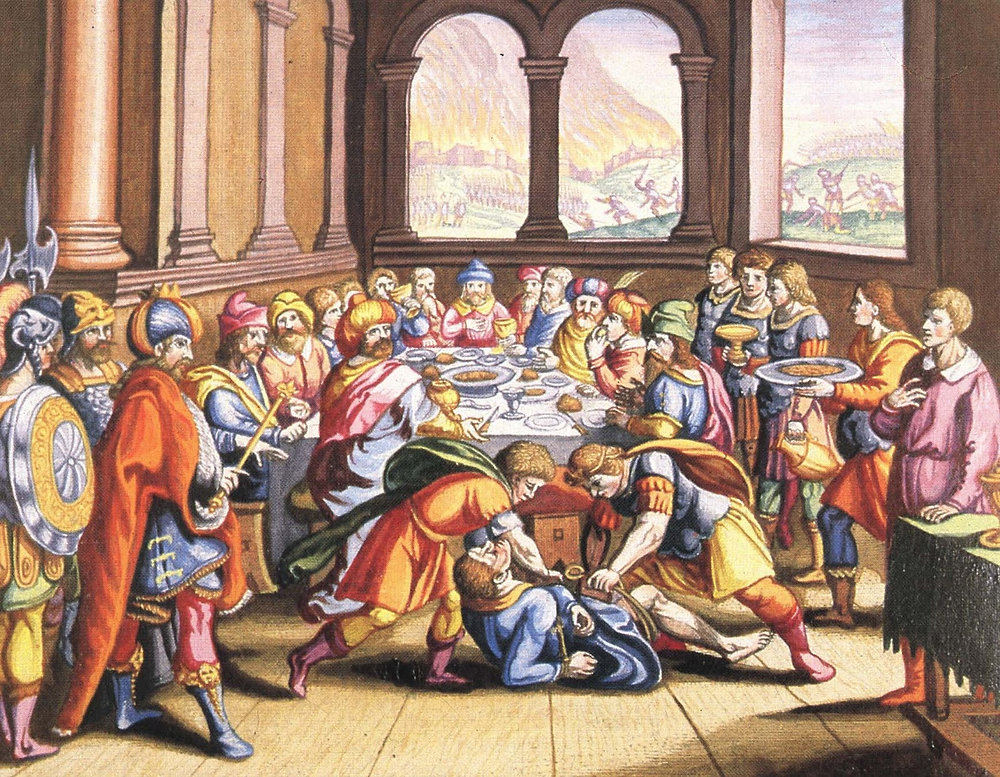
And then comes the verse we would all rather skip: the king comes in to see the guests, and finds a man without a wedding garment. “Friend,” he says — and catch that word, for it is not the vocabulary of fury — “how did you get in here without a wedding robe?” And the man is speechless. The doors close; the darkness takes him.
Why is this man condemned, and what is the garment? In the ancient world, it seems, the king supplied the wedding garments — the robe was provided at the door. The man is not condemned for being poor, or badly dressed, or for dunking his biscuits. He is condemned for making no preparation at all: he treated the king’s feast as ordinary, strolling in off the street exactly as he was, with nothing received, nothing put on. When the king speaks — gently, even warmly — he has no answer. The tragedy of this man is not the wrong clothes. It is the no-response.
So what is the garment? Turn with me to this morning’s epistle: Philippians 4 is the rule book of the wedding feast. Rejoice in the Lord always. Let your gentleness be known to everyone. Do not worry about anything. In everything by prayer and thanksgiving, let your requests be made known to God. Think about whatever is true, whatever is honourable, whatever is just, whatever is lovely. This is the Kingdom’s etiquette — not a set of arbitrary prohibitions, the spiritual equivalent of “never put your hands on the table” — but the habits that fit us for the feast. The wedding garment is not moral perfectionism; it is the day-by-day putting on of a Christ-shaped character: rejoicing, gentleness, prayer, thanksgiving, a mind dressed in what is true and lovely.
And why does Paul think we can manage any of this? “The Lord is near,” he says — near in time, for the feast is about to begin; near in relationship, for the one who invites you wore our flesh and died our death. Then comes one of the most beautiful promises in Scripture: “the peace of God, which surpasses all understanding, will guard your hearts and your minds in Christ Jesus.” Guard — a soldier’s word, a garrison word. If we hand our anxieties to God in prayer, God will post peace like a sentry at the door of our hearts. That is what the King is like: the One whose feast we fear to attend wrong-dressed is the same One who stations a guard on our hearts so that we need not be afraid.
So which is it — fear or anticipation? Here is what my daughter’s pre-holiday training was really about. All those weeks of drilling — and what did she find when she arrived? Not a customs inspection at the door, but a grandmother with her arms open, a plate of biscuits, and a mug of milk. The manners were never the price of admission; they were simply how you learned to live inside a welcome that was already yours. That, says Jesus, is the Kingdom of Heaven. The invitation has already gone out — into the streets and the lanes, to the good and the bad alike, which is to say to every one of us gathered here this morning, from every nation and every table-manners tradition among us. “Many are called” — and the calling is not in doubt. What remains open is our answer: to put on, day by day, the garment of Christ — rejoicing, gentleness, prayer, thanksgiving — until it stops feeling like a costume and starts feeling like our own clothes.
And in a few minutes we shall be shown to our seats at the King’s table. The Lord is near. So leave your apprehension in the pew, come as you are, and eat — for the wedding hall has been filled with guests, and there is a place laid with your name on it.