
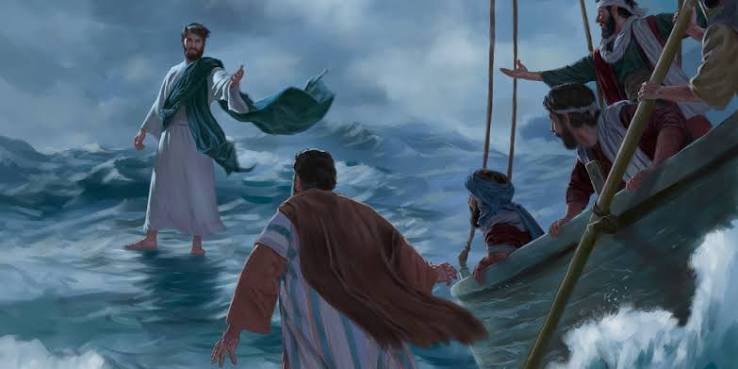
For many of us, much of the time, life is a storm. Whether it’s work, the people we live with, health worries, our financial troubles, or simply what we allow to go on in our heads, life can be heavy weather. And that’s even before we open the newspapers: the attack on Iran, the invasion of Ukraine, burning forests and climate catastrophe – yes, life is a storm.
It would be a cliché to say that we are all in the same boat. Instead, let us say that the church is a boat. Indeed, the body of the church is called the nave – la nave – the church is designed as a boat. And we are all in the boat together – well, at least that’s better than being in the water.
But then we glimpse something moving on the water. Is that a ghost? What does it mean to mistake Jesus for a ghost? A ghost is dead, something from the long ago past; a ghost has no real substance, it just has the power to spook us. Actually, yes, for much of contemporary, secular society Jesus is precisely that: a ghost from the past.
But for us, in this boat, in this church, his words carry across the water: ‘Take heart, it is I; do not be afraid’. Those words come in the exact centre of this story – actually, there are two stories, and these words form the hinge: before these words it has been Jesus’s story, and how he is able to walk, unperturbed, across the wind-whipped waves; after these words it will become Peter’s story as he steps out of the boat, and the disciples story; it will become our story.
As another translation puts it: ‘Courage! I AM. Do not be afraid’. This, in its most essential paired-down form, is the Gospel message. These are the words to inscribe in our churches, over the chancel arch. It should be a banner to hang above the hearth in our homes; these are the words our hearts should murmur first thing in the morning, last thing at night, and with each beat of the day. ‘Take heart. It is I. Do not be afraid’. Learn those words. Pray those words. Incidentally, that middle phrase, ‘it is I’, is the same I AM that God speaks to Moses from the burning bush. It is the I AM of Jesus who says I am the bread of life, I am the vine, I am the truth and I am the way. It is so much more than Jesus reassuring the ghost-startled disciples with ‘Don’t panic, it’s only me…’
And how do those in the boat react to these words? The storm still rages. Jesus is no magic talisman who makes all our problems suddenly disappear; the saving power of God doesn’t come from banishing storms, but by being present with us in them. We are not told how the disciples reacted, though we can imagine their relief. But remember, they have seen all this before: Jesus once stilled a storm when they were travelling in the other direction: then he was in the boat with them, and he was asleep. And they had reacted by asking: what manner of a man is this? Perhaps all of us have some experience of supernatural help, of answered prayers, of putting our trust in things working out when confronted by an impossible situation, as they had.
So having already seen Jesus calm a storm, and despite their amazement at the sight of him walking on the waters, the disciples must have been moderately reassured at the sight of him. But now, one of them, Peter, impetuously clambers over the side of the boat. He doesn’t ask for guarantees, or for promises for his safety. Instead he says, ‘only command me and I will come’. I don’t know if the ratio is right: eleven who sit subdued in the boat, to every one who undertakes the folly of trying to emulate Jesus by joining him on the water. Yet there are Christians, saints and missionaries, who do clamber out of the boat and walk on the water, their gaze fixed on Christ alone. And thank heaven for their example – even if they only manage a few steps before they take fright, and begin to sink.
What does it mean to walk on the water, to start to walk towards Jesus – what does it look like? It means trying to live a supernatural life, one based not on the natural pull of security, comfort, and reputation, but a life spent striving towards Christ’s seemingly impossible standards of love and righteousness. It is a life based on prayer rather than paychecks.
Or perhaps I can put that another way: if you were to decide to follow Peter, to get out of the boat, what would that look like? Would you pray more and find a regular moment to be with God? Would you give more? Either volunteering your time or your money… Or would your first step have to do with relationships? Would you try to repair a broken one, or make yourself more available to people?
I think that if we reflect, we know what that first step on the water would be. It is whatever for you is a step towards Christ, towards becoming more whole and wholesome. It is a step motivated purely by the presence of Christ in our culture and in our lives. For even at night and in open water, Christ can appear beside our little boat, which is our church.