Last Thursday, which was the 18th of June, the Anglican Communion commemorated an African martyr, Bernard Mitzeki, and I want to begin by telling his story.
Bernard Mizeki’s story is one of humble, steady love—proof that God’s work is often done not in grand gestures, but in the quiet, daily acts of faithfulness.
Born in Mozambique around 1861, Bernard left home as a boy and found himself in the slums of Cape Town. Yet even there, he didn’t let his surroundings define him. He worked hard by day and, by night, attended classes at an Anglican school. It was there he encountered Christ, was baptized, and discovered a gift for languages—mastering ten or more, a skill that would later help bring Scripture, prayers, and hymns to African hearts in their own tongues.
His life wasn’t marked by dramatic miracles or earth-shaking sermons. Instead, it was built on small, kindly acts: teaching children, farming the land, learning the local language, praying the daily office, and befriending his neighbours. He built a mission at Nhowe, not with fanfare, but with patience and care. Even when he moved the mission near a sacred grove—a bold act that angered some—he did so with respect and a quiet confidence in Christ’s authority. And yet, it was his gentleness, his presence, that won the trust of the people.
But the most amazing part is what happened immediately after his death.
Danger came in 1896, with rebellion against colonial rule and missionaries were seen as targets, Bernard could have fled. But he chose to stay, refusing to abandon those he served. On June 18th, he was martyred outside his hut. His wife and a female friend hid in the bushes and watched as three unknown assailants dragged Bernard out of the hut: two of them held him down while the third drove a spear into his side. He was still alive when his three attackers fled. This, from an account… is what happened next.
Together the two women stole down the hill to the hut to get food and blankets for him. As they began to climb the slope again, they were almost blinded by a great and brilliant white light. The whole of the hillside was lit up and there was a noise ‘like many wings of great birds’. The noise came lower and lower, and as they crouched on the ground, covering their eyes, the women saw through their fingers that in the centre of the light where Bernard lay, there was a strange red glow. After a long time the noise ceased. The light disappeared, but so had Bernard. They crept up the hillside to the rock above the spring. Bernard had gone. They never saw him again and his body was never found.
To this day, pilgrims visit the site, drawn not just to the story of his death, but to the life he lived—a life of small, kindly acts, each one a seed of God’s love sown in the soil of everyday faithfulness.
I have told you this story because I think it illustrates some of the themes in today’s Gospel—difficult themes. In Matthew ch.10 Jesus is instructing his disciples on how they are to follow him and how they are to represent him. “Do not fear those who kill the body but cannot kill the soul. Rather fear him who can destroy both soul and body in hell.” A few verses later, we hear: “Everyone, therefore, who acknowledges me before others, I will also acknowledge before my Father in heaven.” Bernard Mitzeki was one such—never afraid to acknowledge Jesus as his Lord, and in his death, he was clearly acknowledged before his Father in heaven. Moreover, after such a sweet life of gentle ministry, he was punished by the most gruesome martyrdom. “Do not think that I have come to bring peace to the earth. I have not come to bring peace but a sword.”
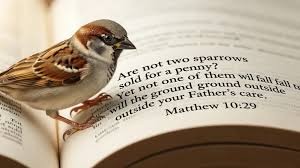
There are indeed many hard teachings in today’s Gospel. And yet, in the same chapter, we read a reassuring note of God’s intimate care for all his followers. “Not one sparrow will fall to the ground apart from your Father. Even the hairs of your head are all counted. There is no bird smaller, or less significant than the sparrow. And no part of the body is less significant than a hair of the head, So it is that God promises meticulous personal care for the very smallest, least significant part of us. Jesus also promises, “Everyone who acknowledges me before others, I will also acknowledge before my Father in heaven.” Acknowledging Christ isn’t just a matter of words but actions. We are not necessarily being called to explain our faith or to convert others, but simply to act in hospitality, justice, and kindness. Elsewhere, we are told that even to offer someone a cup of water is to acknowledge the Lordship of Jesus. Sparrows and the hairs on our head and small actions—the least of these will be counted in our favour and remembered.
When we sit in silence for half a minute after the sermon, I would like to invite each of you to consider one small act of kindness that you can perform in the coming days.