You may recall that Matthew’s Gospel begins with a long list of Jesus’ ancestors: Abraham had a son named Isaac, who had a son named Jacob, who had a son named Judah… It’s a list that goes on for 16 verses. Believe it or not, I once went on a retreat where, for four days, twice a day, the retreat leader preached on nothing else but this genealogy—a total of eight sermons.
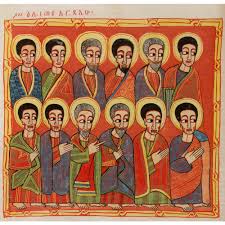
This morning, I want to do something similar – though perhaps not quite as long. I want to base my sermon on the list of disciples we have just heard in this morning’s Gospel. I hope that, as well as reminding you of many of the things you already know about them, I can suggest a few new ideas that you do not.
The list of the Twelve is remarkably consistent. We have practically the same names in almost the same order in each of the Synpotic Gospels, and John’s Gospel, though it has no list, mentions each of the twelve by name. The one difference is that John replaces the name Bartholomew with Nathaniel, proably because Bartholomew was his surname, meaning “son of Tolmai.” So he may well have been Nathanael Bartholomew.
We don’t know much about most of them. Some were fishermen, but we shouldn’t assume they were simple or uneducated. The New Testament shows they could write and write well. The Jewish people of the time were far more literate than most, thanks to their religious traditions and synagogue education. The way the fishing families are described suggests they ran their own businesses—they weren’t mere labourers.
All twelve are generally thought to have been Galileans, though there is some question about Judas. Nine of them have Hebrew names, while three—Andrew, Philip, and Thaddeus—have Greek names, reflecting the strong Greek influence in Jewish Galilee. One wonders how many of them, including Jesus, could speak Greek fluently.
All the lists begin with two sets of brothers: Peter and Andrew, James and John. The concept of twoness—is a feature more emphasized in Luke’s Gospel, but it’s present here too. Twoness protects the Church from personality cults and constantly reminds us how much we need each other.
Only five of the disciples have stories of how they were called: the two sets of fishing brothers and Matthew, who is called Levi in the other Gospels. In each list, it is Peter who heads the list, and Judas who is mentioned last. Matthew gives Peter an emphatic first place, underlining his primacy. Yet throughout the Gospel, Peter is as often first in folly as he is in leadership—he is as often the court jester as he is the disciples’ spokesman.
Judas, who betrayed his Lord, stands as a warning to every disciple. The commentator Matthew Henry, writing at the turn of the 18th century, said that Christ took Judas among the apostles so that it might not be a surprise or discouragement to His Church if at any time the vilest scandals should break out in the best societies. The presence of a traitor among the Twelve perpetually reminds Christians of the mortal insecurity of each and every member of the Church. There is a sense in which this teaches a doctrine of temporal insecurity: just because we come to Church does not mean we are “home and dry.” The Christian life is, after all, a dangerous life.
We can also contrast another pair: Simon the Zealot and Matthew the tax collector. Simon was a member of the Zealot party, a revolutionary group opposed to Roman rule. A Zealot was as far removed from a tax collector as a left-wing guerrilla is from a right-wing conservative. That such disparate individuals could now find themselves in Jesus’ apostolate suggests the power of Jesus to bring very different people into fellowship.
It is encouraging to see how the Church today, especially in contexts like our chaplaincies in Italy, can bring together people from otherwise insurmountable social, political, economic, and class barriers to form a unified, missionary Church.
You may have heard that Jesus chose twelve disciples to represent the twelve tribes of Israel. Yet in Jesus’ own time, only two tribes—Judah and Benjamin—had survived the destruction of the northern kingdom in 722 BC. So His reconstitution of the twelve tribes is anachronistic, romantic even, looking back to a time 700 years earlier. It’s as though a modern leader took as their model King Arthur and the Knights of the Round Table.
Chapter 10 begins with Jesus summoning His twelve disciples. In verse 2, we are told, “These are the names of the twelve apostles.” So what’s the difference between a disciple and an apostle? Disciples are students, people in training. Apostles, which literally means “those who are sent out,” have qualified—they have now become the teachers.
The real difference between disciples and apostles is that the latter have been filled with the gifts of the Holy Spirit.
So what does this mean for us today?
The Twelve were not perfect. They were a mixed bag—fishermen, tax collectors, revolutionaries, and even a traitor. Yet Jesus chose them. He sent them out, not because they were strong or wise or holy, but because He had called them. And He gave them authority—not because of who they were, but because of who He is.
This is good news for us. We, too, are weak. We, too, are imperfect. But Jesus calls us. He sends us out. He gives us authority to proclaim the Kingdom, to heal the sick, to cast out demons—not because of our strength, but because of His. Let us go out, as a diverse, sent community to freely give what we have freely received, and trusting in the power of Christ to work through us, even in our weakness. Amen.