
“Jesus used this figure of speech with them, but they did not understand what he was saying to them.”
Not for the first time, when I began thinking of what I could say about today’s Gospel, I found myself coming face to face with my own misunderstandings. So what I intend to do is to share three of these misunderstandings with you and see where they lead.
There’s a lovely account, published in 1906, in a book entitled Peasant Life in the Holy Land by a certain C T Wilson that describes how the author camped for a night with shepherds near Gilead. About a dozen tents had been erected in a circle, and as the evening went by some six or seven shepherds arrived with their various flocks and herded them all together in the centre of the circle. The next day at dawn, each of the shepherds went outside the circle, to various points of the compass, and each began to call his sheep. Some had musical instruments, such as a simple pipe, others sang, some just shouted out a word over and over again. C T Wilson was amazed to see the one great flock of sheep disentangle itself as the sheep calmly but confidently headed out past the tents to join their own shepherds.
Until I read this, Christ’s words about shepherds calling their sheep by name, and sheep recognising their shepherds, had always seemed a bit unreal, even a bit fanciful. When actually, sheep can, and do, respond to being called. So this was my first misunderstanding: not to have much faith in the shepherd’s call, but also to seriously underestimate the abilities of sheep. These mistakes come, no doubt, from growing up in a country and a culture where most of us are no longer in touch with the natural world, the world of husbandry.
My second misunderstanding was to assume that today’s readings are all about shepherds, and in particular, about the Lord Jesus as the good shepherd. After all, we have just heard that most recognisable of psalms, Psalm 23, beginning ‘The Lord is my shepherd: therefore can I lack nothing’. What’s more, a case could be made that the passage from Acts ch.2, with its celebration of the fellowship and the communal lifestyle of the early church, gives us a picture, in human terms, of what it looks like to be a member of Christ’s flock.
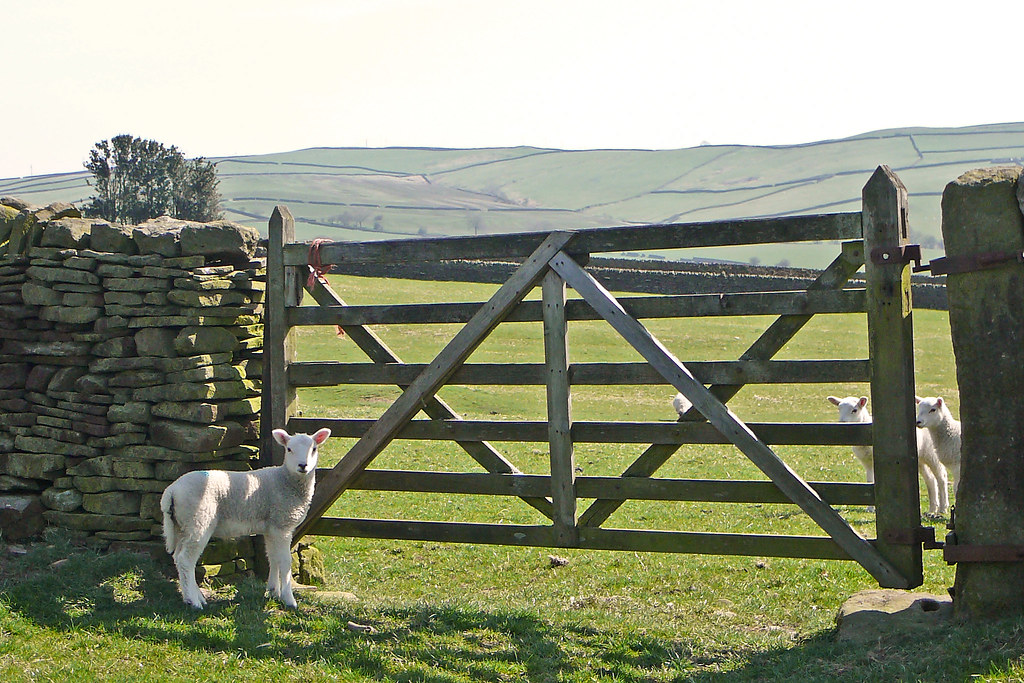
But here’s the thing: in today’s passage from John’s gospel, our Lord is not telling his listeners that he is the good shepherd – that comes later – he is telling us that he is the Gate.
And my third misunderstanding was to imagine that the sheep in the sheepfold are safe, whereas once they go out into the desert they are at risk. However, a closer reading shows that even in the apparent safety of the sheepfold the sheep are at risk from thieves and bandits; while those being led out are taken to green pastures where they can graze beside still waters – out in the world they are safe, they can fatten up.
So what do I think I have learned from these misunderstandings? What lessons are to be found – forgive the pun! – in my woolly thinking? The first is that the Christian life has a rhythm of going out and coming in; although usually it starts with the coming in. We come to religion because we seek a place of safety, somewhere for convalescence and rehabilitation, a good shepherd to tend our wounds, and to clean us up. After that we can go back out into the world – indeed we are sent out into the world. Except for two things: today’s gospel suggests that we are not as safe inside the sheepfold as we might think – there are plenty of thieves and bandits who manage to clamber in over the walls. Whether we interpret the sheepfold as the community of the church, or whether we see it as a metaphor for the interior life, that place where we try to order ourselves from the inside out – our protected spaces can still be dangerous places. Be careful, too, who you let into your hearts and minds: which thinkers, which writers, which leaders, which politicians. Ultimately there is only one dependable gatekeeper, only one reliable shepherd. And the second point is that the world out there need not be such a fearful place: not if you are following the good shepherd, not if you learn to hear his voice. Indeed, perhaps his call is just that: ‘Do not be afraid’ – look at the gospels, it was a phrase that is always on the lips of our Lord.
And lastly, I want to share an experience which I’ve had twice in recent months, which suggests another way of reading today’s gate-to-the-sheepfold gospel. On two occasions there have been people who I really began to detest. And of course I was right to detest them. They were – though in very different ways – selfish, inconsiderate ignorant people; one was rather stupid, and the other impressively intelligent – but knew as much as was obnoxiously arrogant. Not only could I see these people’s vices, but every right-thinking person, I was sure, could see their faults just as clearly as I could. In other words, every sheep in the sheepfold was bleating the same to the same hymn sheet.
Then something happened, first with one and then with the other. Something happened to the first person and I found myself filled with compassion. Then the second person reached out to me in a simple, friendly, but totally unexpected way. And in each case, following these rather trivial incidents, I discovered that my attitude to them – all the animosity and suspicion I had built up against them – vanished instantly, never to return. In an instance of pure grace, the latch of the gate had been lifted, and I was free to leave the sheep-fold of my own prejudice.
So that’s where this Gospel might be leading us: less to a notion that there’s safety in numbers, and protection inside the familiar sheepfold, but more into an invitation to slip out through the gate, providing we recognise the voice that is calling us. I have tried to share an example of what that message has meant for me. But what, I wonder, does the call of this morning’s elusive Gospel mean for you?
Leave a Reply