As I’m sure you are all aware, we are waiting for there to be a new ABC: Dame Sarah Mullally, currently the Bishop of London is going to be formally installed in Canterbury cathedral in March.
So I’d like you to imagine, just for a moment, that next Sunday she comes here, to HGG. She comes unannounced, sits at the back of the church, takes communion with us and leaves.
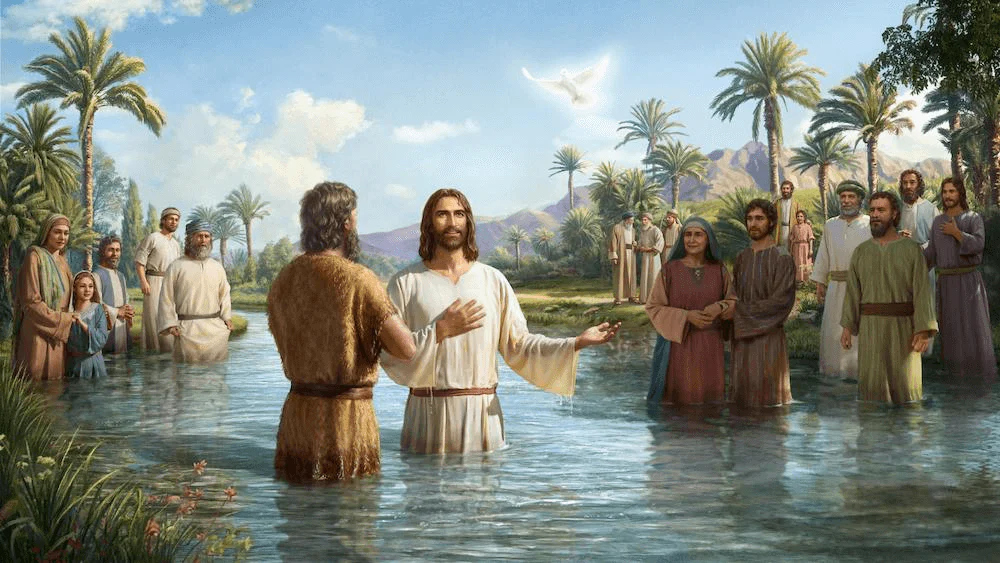
Sounds unlikely, doesn’t it? But that’s the kind of thing that happened at Jesus’s baptism. John is out in the wilderness, running his own baptism gig on the bank of the Jordon, when suddenly the great man appears. No wonder John is reluctant to baptize Jesus, and says, ‘but surely you should be baptizing me?’
There are two other things I’d like you to notice: firstly, that the account of Jesus’s baptism in Matthew’s account is different from the other synoptic gospels; in Mark and Luke it is almost a private moment for Jesus – yes, he goes to John to be baptized, but it is as though the coming of the Holy Spirit and the Voice that speaks over him is a personal experience for Jesus alone. Whereas in Matthew’s account, not only is it a witnessed, public event, but we have the dialogue, the exchange between Jesus and John.
And secondly, we must notice the huge discrepancy between what John was expecting the Holy Spirit to be like – like a fire, like an ax, like a shovel – and how it actually comes: as a dove. Fire power is deadly and destructive; bring out an ax and something’s in for the chop. But the power of the dove? How does that work? Certainly it makes the Holy Spirit sound gentle: it conjures up that lovely image from the psalms of sheltering under the shadow of a wing – of an angel’s wing, perhaps. Given that humans have tamed doves, and built dovecots since the dawn of recorded history, dove power sounds rather domesticated, something to be invoked daily. Supremely, dove power is God’s soft power, and not at all what John the Baptist had been threatening.
And it is dove power, God’s soft power, and a domestic blessing I would like us to invoke this morning. May the Holy Ghost surround little Amelia, her parents Sarah and Jeffrey, and her sisters, Brenda and Lois, and Amelia’s godparents too, as we invite them in a moment to gather round the font.
But what about the rest of us? As we once again listen to and celebrate the story of Jesus’s baptism, what are the implications of this event for ourselves? There are many, and I can only suggest a few directions that we might like to take as we step out into this new year.
One is that the voice that spoke over Jesus speaks over each of us, as God’s adopted children: we too are pronounced God’s beloved children through our own baptism, and through our own association with Christ: after all, Jesus’s righteousness is what gives us the “power to become children of God”.
Secondly, just as his baptism marked the beginning of Jesus’s ministry, so too our own baptism should stand as a symbol for whoever and whatever God is calling us to become. Baptism contains the promise -on both God’s part and our own – to become that better self that some nagging recurrent thought, some corner of the heart, knows to be our true calling. Let baptism stand for that: the clear-sky vision of our best self, aligned with the means – the dove power of the daily spirit – to achieve it.
Finally, baptism is one of the two sacraments instituted by Jesus himself (along with the Last Supper); not only was baptism central to the early church’s understanding of how the individual could be redeemed and transformed but it was also foundational for the way the church could become the engine of change in a fallen world. In consideration of this, we must take our own baptism seriously not just as a one-off event that happened perhaps long ago, but by remembering it as a continuing formative experience in our lives. There are a number of ways you might do this: by rereading our baptismal vows regularly; by acknowledging the font as well as the altar whenever we enter a church; and by recalling our baptism whenever we go for a swim, or even when we take a bath or a shower. It’s not so much the ‘how’ that matters as the habit of commemorating our baptism within us, and keeping its promise active and alive.