Most of us, from time to time, enjoy the game of dividing humanity into two. There are two types of people, we say: night owls and early birds; or there are cat-lovers and dog-lovers.
It wouldn’t be difficult to come up with Christmas versions of the same game: there are two types of family – in Italy, at least – those who celebrate on Christmas Eve and those who celebrate on Christmas Day. Or how about people who prefer Christmas and people who prefer New Year? Or those who prefer panettone and those who prefer pandoro. (Sorry, I’m in Genova now: the obvious answer is Pandolce)
All of this brings me to the question I want to ask you this morning: if I were to say to you that there are two kinds of Christian among us at Christmas time – those who prefer the shepherds, and those who prefer the wise men – which are you?
Most of us, I would like to suggest, approach the infant Christ either with the Magi or with the shepherds. To come with the Magi implies an intellectual journey towards faith; to come with the shepherds implies a shorter, more spontaneous, heart-driven pathway. The church contains, and needs, both: it needs its scholars and its princes, it needs people who are able to enter the palaces and the universities on equal footing with the world’s experts and rulers. Just as much, however, it needs everyday people who respond instinctively, from the heart, to the Kingdom’s message of peace and love and goodwill to all men.
What’s more, I’m sure Mary and Joseph were much more at ease with the shepherds: I can just hear Joseph relishing a joke with one of the them, and I can see the shepherds leaving with a friendly embrace. When the great Eastern potentates came it must have been all bows and curtsies, and Mary dying of embarrassment because she didn’t have chairs to offer them, let alone a decent table-cloth. But while all of this is true, and Shepherds and Magi represent different paths to Christ, Matthew’s Gospel suggests a more serious division than one of temperament or personality. At Christmas, the real divide is not between shepherds and scholars — but between those who welcome Christ’s kingship and those who fear it. In other words, it is the division between King Herod and the Magi.
King Herod, as we learnt last week was cruel, vindictive, and insecure. He was also a liar, pretending that he wanted to know the whereabouts of the Christ child so that he could worship him, when his real intent was to murder him. Herod was one of history’s arch-villains. But here’s the thing: Herod is not just a monster from history; he is our mirror. There is a King Herod inside us all: like Herod, we are all false kings. What’s more inside each of us there is a natural instinct to protect our own little realms, our own little power structures at whatever the cost – and that probably involves paying lip service to the Messiah, while secretly plotting to murder him. Let’s be honest: the natural man wants no God but himself. Our first instinct when we come into the shadow of Holiness is to run and hide; the second is to sneer and to lash out. Whenever Christ threatens our control, our comfort, or our status, something of Herod stirs in us.
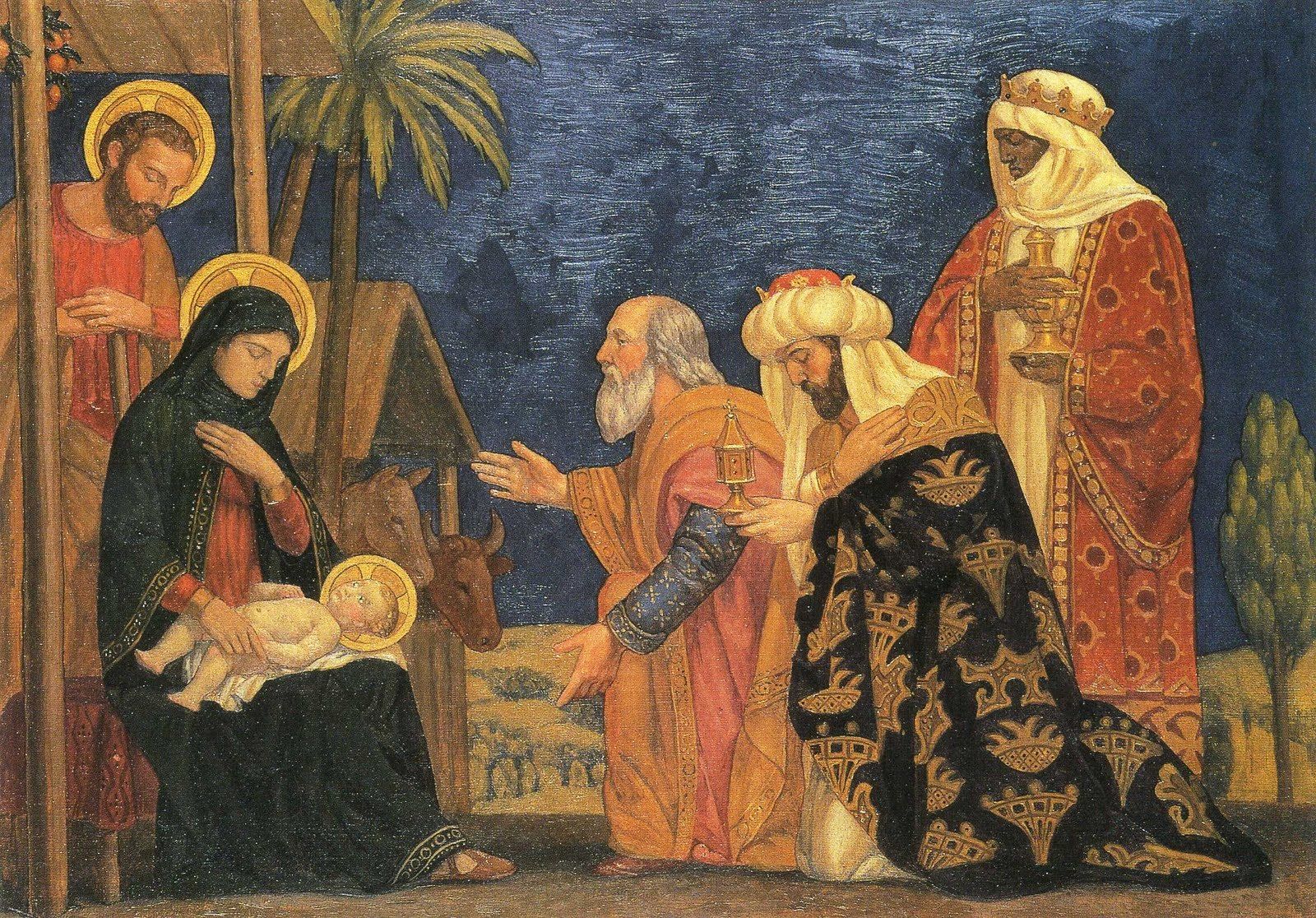
Let us end by contrasting King Herod with the Magi, or the three Wise Men as they are often called – the Three Kings. Incidentally, nowhere in the new Testament are they referred to as kings, nor are we told that there were three of them. Somewhere along the line it was assumed that there were three of them because they bring three gifts – gold, frankincense and myhrr; but perhaps there were only two of them, or maybe twenty. Anyway, the Magi have travelled far to reach the Christ child, they have made a journey that has been costly and no doubt dangerous as well. Like Herod, they have power and status and wealth – but they do not hesitate to place it all at Jesus’ feet. What’s more they haven’t come just to check this wonder child out – it isn’t just curiosity that motivates their journey – they have come to worship him.
And that, I think, is where this story finally leaves us — not with shepherds and scholars, not with intellect or instinct, but with a choice. Herod and the Magi stand before the same child, yet they respond in utterly different ways. Herod clings to what he already has. The Magi open their hands. Herod guards his throne. The Magi kneel before another.
The difference is not knowledge, nor culture, nor even belief. It is surrender. True worship, Matthew seems to say, always costs something: time, security, reputation, treasure. The Magi give gifts fit for a king, not because the child demands them, but because love and awe leave them no other response. They discover, perhaps to their surprise, that in losing nothing they lose everything — and in giving everything they lose nothing at all.
And then there is this final, quiet detail: warned in a dream, they return home by another way. An encounter with Christ always does that. It changes our direction. It sends us back into the world differently.
So as we leave the crib this Christmas, the question is not whether we come as shepherds or as Magi. It is whether we come like Herod, defending our little kingdoms — or like the Magi, laying them down, and finding, in worship, a joy great enough to lead us home by another road.