
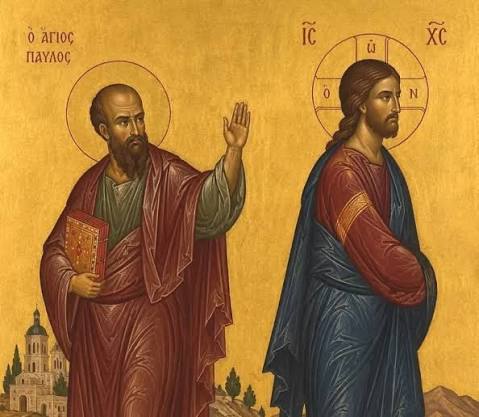
We have heard two short readings this morning, one from Paul’s letter to the Romans, and the other from Matthew’s gospel, and in looking at them two questions come to mind: what do they have in common, and what is most interesting about each of them?
Some Christians, and many critics of Christianity, make a big deal of the difference between Paul and Jesus: it’s even said that St Paul was ‘the founder of Christianity as a religion’, or that their messages were different. Although I don’t buy into such an argument myself, it can be summarised as follows: for Jesus, salvation is all about trusting in God as a loving father who is close at hand, and about obeying the Law as Jesus himself was re-interpreting it – as a law of the heart, rather than a law of outward observances; for Paul, salvation was all about trusting in the death and resurrection of Jesus, and faith in Jesus replaces the Law; what’s more, Paul hardly mentions Jesus’s teaching at all. Besides that, Jesus was concerned with instructing his twelve disciples, while Paul was busy setting up and regulating new churches.
Most of these differences can be explained simply by their ministries occurring at different stages, as well as the obvious fact that Paul’s ministry took place after, and in the light of, the resurrection. After all, Christ’s resurrection is the rocket fuel of the Christian faith.
So, to return to that initial question – what do today’s readings have in common? – amazingly, the passage from Paul sounds as though it could have been lifted from one of the Gospels, while Jesus’s explaining how to deal with difficult members of the church is quintessentially Pauline territory. Listen to this excerpt from Romans again: “one who loves another has fulfilled the law. The commandments… are summed up in this word, ‘Love your neighbour as yourself.’” This is Jesus’s teaching, almost word for word. And what about “now [is] the moment for you to wake from sleep”? Doesn’t that remind us of the parable of sleepy bridesmaids, or Jesus pleading with his disciples not to sleep in the Garden of Gethsemane?
Whereas Jesus’s detailed account on how to deal with straying church members – tactfully, privately, and avoiding gossip – doesn’t that seem to be far more Paul’s territory than his own?
Drawing attention to this apparent cross-over provides an opportunity to underline the continuity between the teaching of Jesus and that of Paul – for some reason Paul’s writings always seem to require explaining and defending with contemporary audiences, which just goes to show how far most of us, even regular church-goers, have strayed from a truly Christian mind-set. Indeed, one of the issues he raises here, is how far should our Christian faith influence our behaviour and differentiate us from our non-church-going neighbour? Fifty years ago, many Christians, and many churches, had different attitudes to drinking, dress, smoking, and acceptable forms of entertainment from their secular neighbours. Has that now all gone? How do we ‘live honourably, as in the day’? That, surely, is the essential question that this passage from Paul’s letter to the Romans is asking us to consider. How does our faith influence our behaviour? We all have to ask ourselves this question: what might it mean for me to ‘lay aside the works of darkness and put on the armour of light.’?
Turning to the second question – what is most interesting about each of these readings? – I can only give my own answers. The phrase that leaped off the page at me in the Romans passage was one right in the middle: ‘Besides this, you know what time it is’; a phrase I might well have passed over until I came across a different translation: ‘And do this (that is, put love first), understanding the present time.’ But the New International Version translation got me thinking: do we ‘understand the present time’? To quote from The Tale of Two Cities, it seems that these are the best of times, and the worst of times: the tail-end of a golden age of wealth, leisure, and luxurious living standards that we in the West have enjoyed for decades, giving way to a world of pestilence, war, and run-away climate change. But that’s not what Paul meant: Paul meant faith time, the time when salvation is near, when the night is far gone and dawn is about to break – if only we let it. But none of these considerations were where my thoughts went as Romans 13, verse 11, urged me to consider what time it was, and to understand the present time – my thoughts, even my hands, went where all of us instinctively seem to go in the present age: they went to my mobile phone. Now isn’t that an instrument designed for making provisions for the flesh, and for the gratifying of desires? Don’t get me wrong, I love mobile phones, and what they can do – if I had been told as I boy that in my lifetime I would have such a device, I would have thought it sheer magic. At the same time, though, what a time-waster, a temptation, an addiction… As Christians, we all need to work out what it means to live honourably in the day of the mobile phone, to ensure we use them as instruments of love and of self-love.
Finally – and briefly, because I do know what time it is – the line from Matthew’s Gospel that I want to leave you with is the one about ‘wherever two or three are gathered in my name…’ Jesus gives greatest power in the church to the smallest prayer group. Judaism traditionally requires ‘ten men’ to recite many of its public prayers, and Luther commented that with this verse Christ gives the power of the keys to the whole church, to all disciples. Indeed he began a sermon on this verse by saying: “Now Jesus gives his keys to every single house”. This small group Christianity, or household Christianity, is the basic building block of the Christian church. What I wish for all of us, and for every Christian, is to have at least one Christian friend to share our faith and our journey with.