
Today’s message, the Easter message, consists of just one word, and it is a Greek word: Egerthe. In English we need four words to translate Egerthe: ‘He has been raised’. On this one word, the Easter message, the whole gospel, and the whole Christian religion rests like an inverted pyramid.
From this one word, which we proclaim today, three implications follow: first, there is a God, the one Jesus calls ‘father’, who does the raising; second, there is an answer to be found, in a witnessed historical event, concerning the nature of death, and each of us has a real and responsible hope of surviving our own death; and thirdly, it follows that each of us has a purpose and a rule of life, which is to be found in Jesus’s teaching.
So much hangs on this one word Egerthe – ‘He has been raised’. But is it true, or is it false? There is no way any Christian alive today can prove it; only the Gospel can prove it. I found that a comforting thought when I was considering what to say today: it isn’t my job to persuade anyone that the resurrection took place. I can’t. All I can do – all any of us can do – is repeat the proclamation which the Church has been making every Easter Day for nearly 2,000 years, and talk again of what was witnessed, and of what has been re-membered.
And in particular, I want to say something about Matthew’s account of that first Easter morning, as it is Matthew’s take on the proclamation of Egerthe that we have read out this morning. For certainly, the four accounts of this extraordinary morning differ, and the details don’t quite tally; overwhelmingly, though, the four accounts are remarkably similar to each other. None of them tries to present the moment of Christ’s resurrection in itself; they limit themselves to what happened afterwards. All report the same emotional reactions in those who witnessed the Easter morning: the same mixture of fear, perplexity, doubt, then joy. They all agree too on the physical nature of the risen Jesus: this was not a ghost or a spirit, but a solid, eating, walking-talking human being who was nonetheless elusively different, capable of appearing beyond locked doors and who wasn’t immediately recognisable. All insist that the fact that something uncanny was afoot that Easter morning was discovered first by women, and all insist that one of those women – and in John’s account it was her alone – was Mary Magdalene. As you may well have heard before, the prominence that all four gospels gives to women is unlikely to be something the evangelists made up: women were not regarding, in the Jewish culture of their time, as reliable witnessing; their testimonies were not even accepted in a court of law. A gospel account designed to convince would not have starred women as its chief witnesses.
But let us look more closely at this particular account. What is Matthew’s take on the Egerthe moment? Let me say something briefly about how Matthew presents each of the participants: the angel, the two Marys, and Jesus.
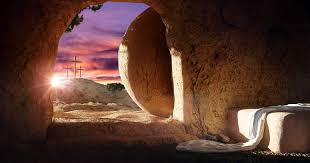
Anyone of a rationalist turn of mind might be inclined to dismiss angels out of hand, yet angels as messengers, as metaphors for truth-carrying, life-transforming moments shouldn’t be too hard for even the most flat-footed rationalist to grasp. Besides, the angel’s invitation to the two women to ‘Come, see the place where he lay’, can be taken as an invitation to investigate the Easter event with full historical and scientific scrutiny.
Next, we should note the very down-to-earth, practical message this angel has for the two Marys: they are told to proclaim the Egerthe to the disciples and to urge them to return to Galilee. Incidentally, isn’t this how the Father, or his angels, speaks to us? Not by granting mystical visions and sending us on world-changing missions, but by nurturing us with small, everyday truths, and nudging us to perform practical everyday loving tasks?
The Marys then leave the tomb and seem to run smack into Jesus. What do they do? They grab his feet and worship him. That short phrase contains a wonderful juxtaposition of Christ’s two natures: the human and the divine. It is also a testimony to the very physical reality of the resurrected Christ. Besides, in folklore the world over, ghosts have no feet. Yet they grabbed his feet and worshipped him.
Incidentally the women who witness the empty tomb have very different outcomes in each of the synoptic gospels: Matthew’s two Marys tell the disciples and are believed; Luke’s women tell the disciples and are NOT believed; and Mark’s women are too afraid to tell anyone at all.
But what of Jesus? At first glance he does nothing more than repeat the angel’s message word for word: ‘Do not be afraid; go and tell my brothers to go to Galilee; there they will see me.’ But notice two things: first he greets them. In the translation we are using, we are given the rather stilted word ‘Greetings’. Actually, the Greek work chairete is much less formal. The Italian word ciao comes much closer. In reminds me of that wonderful moment when Pope Francis was elected and he came out onto the balcony to greet the waiting crowds with a simple, Buona sera! And the other small but significant word that Jesus has to offer the two Marys is to call the disciples ‘brothers. ‘Tell my brothers to go to Galilee’. How much love and forgiveness there is in that one word, after they had all deserted him.
I have one final point: this instruction that they go to Galilee. It’s a hundred mile walk! It is also unique to Matthew. In Luke the action stays in Jerusalem; in John the post resurrection appearances take place partly in Jerusalem, and partly by the sea of Galilee. Yet Matthew insists that the disciples must now make a long journey.
Well, we too are encountering the risen Christ on this Easter morning. Hallelujah! And yet our meeting with Jesus, our grabbing his feet and worshipping him, is but one moment, for all its intensity. After our first embrace with the Christian faith, even after years of commitment, such as the disciples had, Christ greets us with the instruction to go on to Galilee. Wherever we are on our faith journey we still have many miles to go. But let us travel on in joy, in the joy of this Easter morning. Egerthe: ‘He has been raised’.