
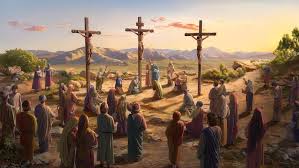
Good Friday invites us to pause at the foot of the cross, not as spectators but as participants in a mystery that redefines both life and death. The cross is not merely a historical event; it is a living emblem, a “concise symbol of infinite meaning,” as one theologian put it. It is both window and mirror: a window into the heart of God, and a mirror reflecting our own struggles, fears, and hopes.
At the cross, we see God’s love in its most raw and unfiltered form. Jesus, in his final moments, does not offer easy answers or quick fixes. Instead, he enters into the depth of human suffering—abandonment, betrayal, physical agony—and transforms it. The cross reveals a God who does not stand aloof from our pain but immerses Himself in it. As the document notes, “The cross is used in Christian prayer as an extremely concise emblem of infinite meaning, a summarizing image of the whole Christ event.” It is here, in the shadow of the cross, that we learn to say “God” and “death” in the same breath, not because death is glorified, but because love is stronger.
The cross also exposes the urgency of life. Jesus’ life and teaching remind us that heaven is not a distant promise but a present reality, just “down the road.” Yet, we often complicate this journey with our own fears and egoism. The cross calls us to simplify, to trust, and to let go.
The cross does not let us look away from death. It forces us to confront it, not as an abstract concept but as a part of our own story. “Death kicks down the door and lets the elements in,” the text says. It is the great equalizer, the reality that shapes how we live. But the Christian view of death is not one of despair. It is a view tempered by resurrection hope, yet not so quickly that we skip over the darkness. As the document warns, “To move too quickly to the joy of Easter produces a facile and superficial religion of answers to human problems.”
Good Friday teaches us to sit with the tension: to acknowledge the pain of loss, the outrage of evil, and the mystery of suffering, while still holding onto faith. It is in this tension that we find solidarity with all who have gone before us, especially those like Mary, who watched her son die and faced the temptation to believe that all was lost.
The cross also reveals a love that transcends time. Christianity does not just remember the dead; it actively loves them. “A religion of love must remember the dead,” the text reminds us. Our love, when rooted in Christ, is not limited to the present. It reaches backward to those who have shaped us and forward to those who will come after. This love prays for the dead as naturally as it does for the living, recognizing that in Christ, we are all one.
Good Friday is not a day for easy answers. It is a day for standing in the light of the cross and letting it illuminate both the beauty and the brokenness of our world. It is a day for gratitude—for the life, death, and resurrection of Jesus, and for the way he continues to “make a huge difference to the life of the world.”
As we reflect on the cross today, let us ask ourselves:
- Where do I see the love of the cross in my own life?
- How can I enter more deeply into the mystery of Christ’s suffering and resurrection?
- Who are the “dead” in my life—those who have gone before me or those whose memories I carry—that I can love more intentionally today?