
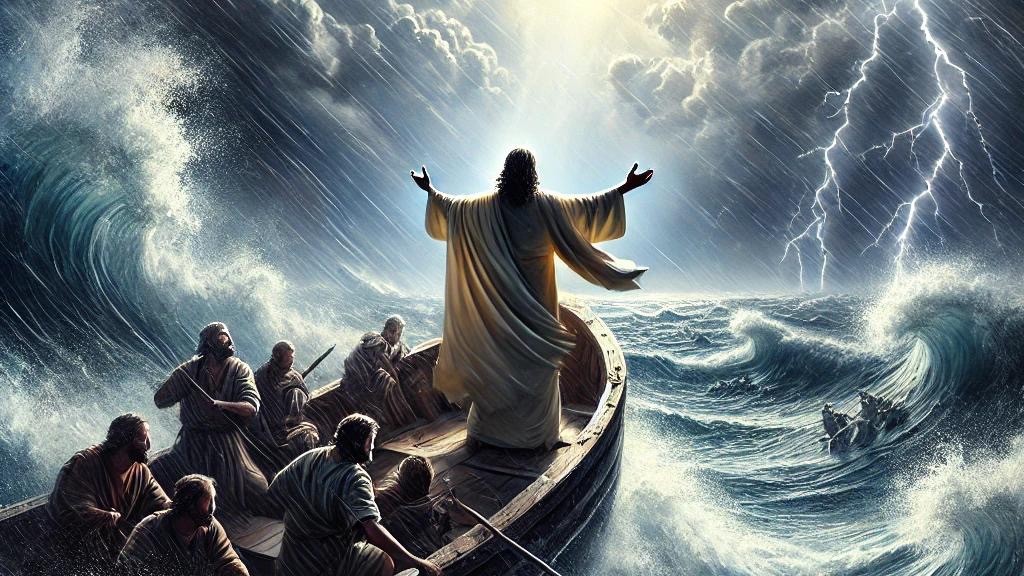
“Lord, save us. We’re perishing.” The disciples were soaked through to the skin, terrified, shouting over the wind to a sleeping Messiah. And when the sea goes suddenly unnaturally flat, they ask the question that the whole Gospel turns on: “what sort of man is this, that even the winds and the sea obey him?” And that question, too, is at the heart of this new feast in the church’s year that I was talking about at the beginning of the service: the Feast of Christ in Creation. Saint Francis, whose feast we celebrate today, answered the same question by preaching sermons to the birds and befriending a wolf, and with a song—his glorious Canticle Of The Creatures .However, six centuries before Francis, the Celtic saints were also giving their answers to the same question, on the far western edge of Europe, with stories of otters and crows, bears and blackbirds, and more than one storm stilled with a word of prayer. It is that world, on the northwest rim of our tiny islands off the northwest coast of Europe, that I come from, and I want to share some of their stories with you today.
However, let us begin with today’s epistle, because at the beginning of his letter to the Colossians, Paul paints the big canvas—the cosmic canvas—even before Matthew shows us our Lord calming the storm on the Sea of Galilee. Paul tells us that Christ is the image of the invisible God, the firstborn of all creation. In him all things were created, in heaven and on earth, visible and invisible. All things were created through him and for him, and in him all things hold together. And through the blood of his cross, God is pleased to reconcile to himself all things, whether on earth or in heaven. This concept of the cosmic Christ can be a bit difficult to get your head around, but count how often Paul says it. And notice how he refuses to let the list shrink: not just all people, not all souls, but everything. The scope of the cross is exactly the scope of creation: wolf and whale, wind and sea, blackbird and bear. The blood of Christ is not merely a private transaction between God and humanity; it provides a cosmic homecoming.
Yet when we come to today’s Gospel, we move from the entire cosmos to a much smaller canvas: a boat, a storm, a sleeping Lord. He rises and rebukes the winds and the sea. BTW, He uses the same word he uses on demons, and suddenly there is dead calm. The elements do not merely quiet down; they obey. The sea recognizes its maker before the disciples do. This is not a display of power; it is creation responding to its creator. Now, if Christ reconciles all things, not merely all people, but the whole of creation, then the reconciled life should look different, after his coming, from the world as it was before, and from the world that we see around us most of the time. And for 600 years, on the islands and in the forests of Cornwall, Wales, Ireland, Scotland, and Northumbria, it did on occasion look different. So let me share with you some of the stories of the Celtic saints and their relationship with nature.
Saint Cuthbert, crossing the sea to Lindisfarne in a small boat, also found himself in the middle of a sudden storm, and his companions gave themselves up for drowning. He prayed, and the sea went flat. Saint Columba, on the Scottish island Iona, knew by insight that some of his Irish brethren were in a boat that had been seized by the great whirlpool of Corryvrecon in Irelandabout to be be sucked down to certain death; and from Iona, out of sight and out of danger, Columba prayed, and the boat was delivered. On another occasion, Columba was passing Loch Ness when a monster rose out of it, about to gobble up a swimmer. Columba made the sign of the cross, and it fled. Adamnon, his biographer, says that it fled more quickly “than if it had been pulled back with ropes”. This, incidentally, is the first recorded sighting of the Loch Ness monster. But notice what these stories claim and what they do not. The Celtic saints do not still storms in their own name. The wind obeys them because they obey Him.
However, it is the gentler stories that preach the message of Saint Francis better, because they are about reconciliation, not command.
So let me share some of those stories with you. It was Saint Cuthbert’s habit to stand all night in the cold North Sea, reciting the psalms until dawn. One night, says the Venerable Bede, two otters rose from the water, breathed warm breath on his frozen feet, and dried them with their fur. He blessed them, and they slipped back into the waves. On another occasion, a crow was seen stealing the thatch from the roof of the guesthouse. Cuthbert rebuked it, and the bird returned the straw; and then, as if doing penance, he brought back a gift of lard for the guests. Cuthbert also decreed protection on his island for the nesting eider ducks, and the islanders have kept that law for centuries. They are still known in that part of the world as Cuddy’s Ducks, and this perhaps is the oldest bird protection law in Britain.
Another saint, Saint Kevin in Scotland, prayed with his arms outstretched for so long that it is said that a blackbird nested in his open hand, and he held it until the eggs hatched and the fledglings grew big enough to fly. If you want an icon, an image of Colossians 1, perhaps this is it: reconciliation needs patience. All things need to be given time to come home. Another saint, Saint Columbanus, who came originally from Ireland, ended his days just over the hills from Genoa in Bobbio, having spent much of his life in what is now France and Switzerland. While he was in the forests of what was then Gaul, he found a cave that would have suited his purposes perfectly, except that it was occupied by a bear. So he asked the bear, very politely, to leave, and it left. What’s more it is recorded that the squirrels and the doves would come and eat bread out of Columbanus’s hand.
So having shared some of these stories with you of the power over creation that the Celtic saints held in our Lord’s name, and the intimacy that they enjoyed with the natural world, I want to come forward six centuries: we note how Saint Francis answers the same questions in the same key: he preached to the birds, and they did not fly away. He bargained with the wolf of Gubbio, and the wolf extended a paw. And at the very end of his life, ill and going blind, he wrote that marvellous Canticle Of The Creatures: “Praise be you, my Lord, with all your creatures, brother Sun, sister Moon, brother Wind, Mother Earth.” We might like to think of this Canticle Of The Creatures as Colossians chapter 1 put to music. Francis simply took Paul at his word and treated every creature as a fellow creature of the same Christ. Cuthbert’s crows and Kevin’s blackbird, and Columbanus’s bear are the older cousins of the wolf of Gubbio.
So what do all these stories have to do with us? I would like to suggest that they have two applications for us today, one for each of this morning’s texts. First, if Christ reconciles all things, then reconciliation with creation is not optional for Christianity. The eider ducks were protected by Cuthbert because a 7th-century hermit believed in Colossians chapter 1. What, I wonder, would Cuthbert protect today? The hedgerows and the rivers certainly, but also our plastic-filled oceans, our deranged climate, and the many species now on the edge of extinction. Secondly, the disciples asked, “What sort of man is this?” But we must ask another question: “What sort of people are we?” The Sea of Galilee knows its maker, but we who carry his Spirit are the ones who so often forget.
So let us return to the boat, the drenched and fearful disciples, and the sleeping Lord. What sort of man is this that even the winds and the sea obey him? Ask the blackbird in Kevin’s outstretched hand. Ask the otters curled around Cuthbert’s feet. Ask the bear in Columbanus’s cave. Ask the wolf of Gubbio. They are all answering the only way that reconciled creatures can: by being at home with him. And the one who stills the storm, in whom all things hold together, is still in the boat with us. The storm – and there are many – is an invitation to trust the one who is already with us in the boat.