
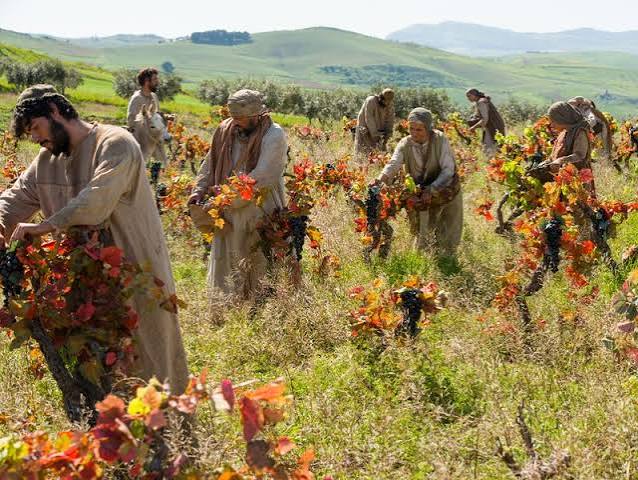
“My ways are not your ways,” says the Lord, “and my thoughts are not your thoughts.” Isaiah. That in many ways summarizes the point of the parable that we have just heard in this morning’s Gospel. It is known as the parable of the workers in the vineyard, and it has similarities with the parable of the Prodigal Son and also the Good Samaritan. In all three, it is the least expected people who are blessed by God and welcomed by God. It is a despised Samaritan who Jesus holds up as the perfect model of good neighbourliness, and it is the spendthrift, wasteful, scoundrel of a son whom the Father not only welcomes back but provides a great feast for. And in today’s parable, it is the workers who have only done an hour’s toil who receive just as much as those who have been working since 6 o’clock in the morning. All three are stories of generosity and grace. The owner of the vineyard lavishes money on those workers who don’t seem to deserve it. The Father seems to welcome and to love the Prodigal Son even more than the dutiful son, and the Good Samaritan cares for the unfortunate man lying in the road as though he were his own brother.
Another thing that today’s story of the vineyard workers and the Prodigal Son’s story share is an emphasis on the streak of envy and resentment in some of the more fortunate characters, those that were hired early in the morning and who’ve worked all day, and the dutiful elder brother in the Prodigal Son resent the generosity extended to those they feel merit such treatment less than themselves.
Now, I’ve mentioned how today’s parable is similar to those other two. I want to mention two ways in which it is different from them. Let’s start with a rather nerdy point. The Prodigal Son and the Good Samaritan are found in Luke’s Gospel, and only in Luke’s Gospel. Today’s parable of the workers in the vineyard is found in Matthew’s Gospel, and only in Matthew’s Gospel. The second difference is this: whereas the Good Samaritan and the Prodigal Son have an immediate impact and appeal, and we get them as soon as we hear them, the workers in the vineyard story is problematic. How many of us, on hearing this, thought, “Yes, of course I get it”? I can’t see any hands going up. And who metaphorically, at least, scratched their head and wondered, “What’s this all about?” I’ve certainly always been rather puzzled by this story.
So even now, I wouldn’t claim that I can explain it to you, but I hope to make a few comments. Observations that will help. First of all, I don’t think that the original audience would have been scratching their heads; they would have been laughing. We mustn’t overlook the humour in this story: the rather dotty vineyard owner who keeps going back to the market square to hire more labourers; the surprise and joy of the luckless underemployed, who receive a full day’s wage for an hour’s work; then there’s the complaints and consternation of those who have been working all day and receive no more. I’m sure Jesus enjoyed telling this upside-down story, and his audience would have seen the glint in his eye. Indeed, the Bible is full of funny stories, yet we have been conditioned not to laugh when we’re in church. Incidentally, perhaps the biggest hoot in the Bible is the Book of Jonah, about the anti-prophet who gets his call from God and runs off to the ends of the earth in the other direction. Yet we’ve been taught to remain po-faced, so we miss not just the original meaning but also the fun.
That said, though, Jesus was no stand-up comic, and he told this story for a purpose. The most obvious takeaway is his criticism of the straight-laced, upright types, here, the day labourers; elsewhere, the dutiful elder brother in the prodigal son story, and -throughout the Gospels – his criticisms of the Pharisees. So beware, anyone who takes thier religion too seriously! The message would seem to be that no one can outwork another in the kingdom of God. And the last (for example, the deathbed convert, a prodigal child) are as welcome and beloved as the first, the lifelong believers. And yes, to many of us, God can seem unfair. I wonder how many of us feel short-changed by God’s blessings of other people. If you think through your family, your acquaintances, and your friends, does anyone come to mind who seems to have had an unfairly easy time of it? If I’m honest, I’ve certainly seen others with that attitude. Well, the moral of this parable is we shouldn’t carry such resentments; God is certainly within his rights to treat others as he wishes, and we are not entitled to resent that or them.
The other lesson from this story, the other side of the coin, is that this is good news for the rest of us the lost, the limping and the blind. No one has missed the boat. For those who feel left behind in faith or in life, this parable assures us that God’s timing and generosity are perfect.
However, I have my own slightly more idiosyncratic understanding of this parable. Perhaps to work in the vineyard is to know what we are doing with our life, whereas to stand idly in the marketplace is the situation of those people, or of those times in our lives, when we really don’t have any sense of what we’re doing. Indeed, one of the saddest comments on our times is that there seem to be so many people without any purpose or goal. Life is often wasted away in distractions – watching Netflix or playing video games. We are living in the age of the anti-hero; it is difficult to extend ourselves or dedicate ourselves. The world will forever say, why bother? We need to know that if we do not aim high, we will not reach high. Without commitment on our part, nothing will happen. And yet commitment does not come out of thin air. It has to be given to us. We need the owner of the vineyard. Speaking from personal experience, I know I was drifting between the age of about 30 and 50. As I’ve said here before, that was the age when an experience of God came into my life: so I would count myself not with those hired at the eleventh hour, but certainly with the mid-afternoon workers. At any stage, however, the owner of the vineyard can come round and set us up with a purpose and a future. Grace is always available to make life meaningful. May all of us be blessed with vineyard owner! Amen