
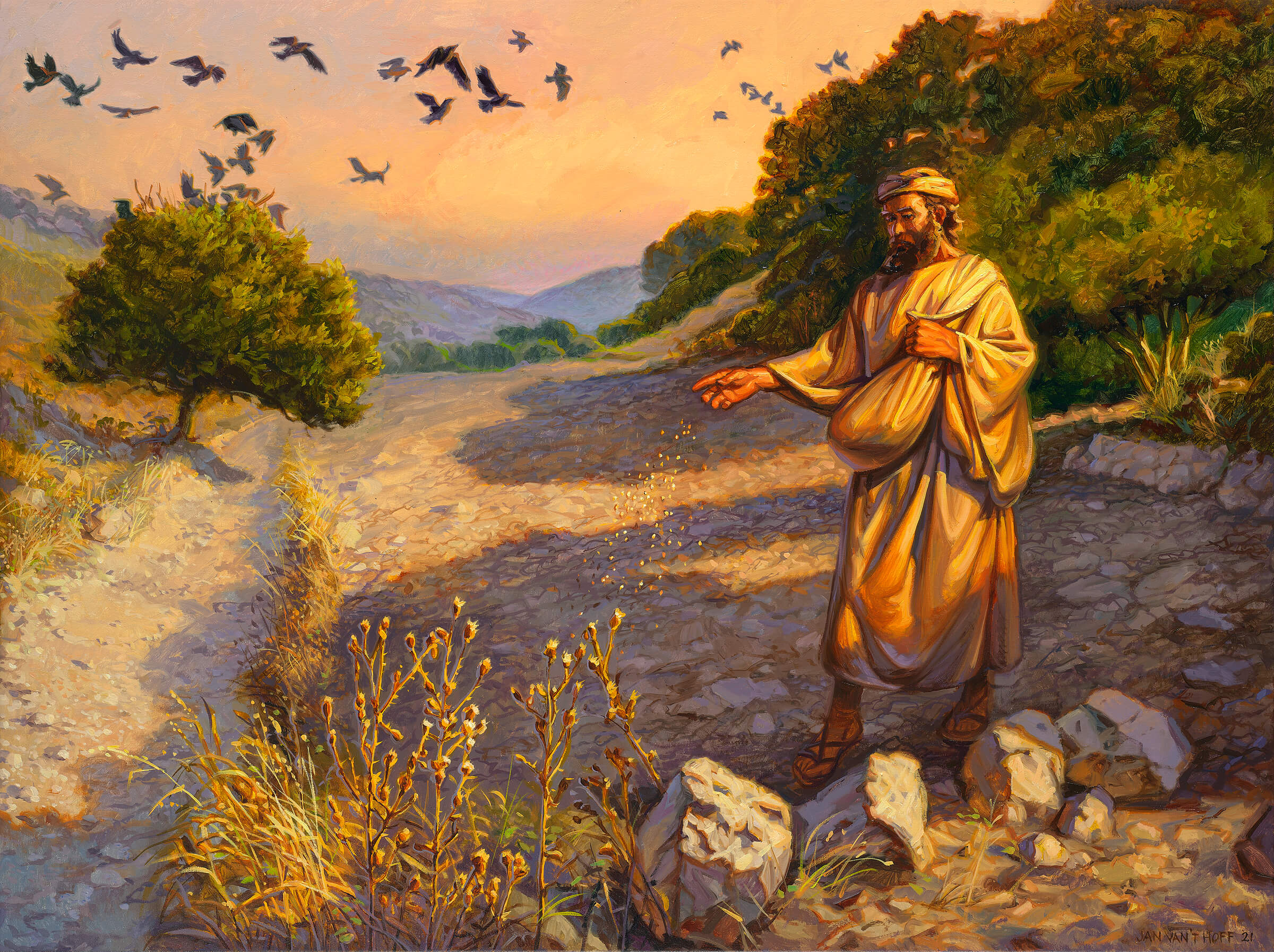
We have just heard – I’m sure not for the first time – the Parable of the Sower. Indeed, it is such a familiar story, and even at face-value, such a straightforward one, that the preacher’s job has to be to get their listeners to hear it with fresh ears.
But first, a word about the context, both where it comes in the Gospel, and where, topographically, this story was told: Chapter 13 of Matthew’s Gospel contains seven parables, six of which start with the words “the Kingdom of Heaven is like…” But before we hear any of these we are given that charming setting of Jesus coming out of his house, pushing through the crowds, and clambering into a boat so that he can preach to them. James Martin, the American Jesuit writer, says that on his trip to the Holy Land, when he visited the Sea of Galilee he went to the bay where this preaching is supposed to have taken place: to his surprise, looking up from the beach he could actually see the four different soils that Jesus describes in the semicircular slopes that rise up on the hillside: most of humanity is crowded along the footpath – on ground too solid for anything to take root. Then there is the rocky soil – a thin layer of top-soil over limestone, which is highly typical of the Palestine landscape: this absorbs the morning dew & encourages seeds to germinate easily, but then the midday sun dries it out so completely that all the seedlings wither. There are also patches of thorn, and pockets of fertile wheat. So the landscape, with its four soils is highly realistic. And I’m sure it is this realism, this down-to-earth-ism, is what makes the Parable of the Sower so memorable.
However, the one element which isn’t realistic is the title of the parable. If you think about, there are no such people as sowers – it isn’t a job – it is simply one of the many tasks performed by those who work the land; and come to that, our Lord’s story isn’t about the sower anyway – it doesn’t even mention him. Nor is it about the seed – it is about different kinds of soil, it is about the people listening to him, then and now, it is about us. Except for one thing: no real farmer would ever have behaved like this: seed would have been precious, it would have been expensive. Any real farmer, would have been careful to sow it in the good soil only; Jesus’s Sower, however is scattering it everywhere with reckless abandon. God scatters his Word everywhere, on the deserving and the undeserving.
But to get back to the Kingdom of Heaven: the original Palestinian audience would have understood it as a renewed political Kingdom, one which finally threw over the conquering, imperial forces that had oppressed and corrupted the Kingdom of Israel for centuries – first the Greeks and then the Romans; they were thinking of the kingdom David, restored; a return of Israel in its hay-day. Christian audiences, on the other hand, tend to associate heaven either with the afterlife, or with a state of perfected human existence which is promised after our Lord’s return – that event at the end of history known in Greek as the parousia, and in English as the Second Coming. Or – and I think this is really worrying – some Christians are tempted to read this as a parable about who gets saved.
So what is this Kingdom of Heaven? Perhaps we could replace the word ‘kingdom’ with the word ‘dimension’. ’The Kingdom of Heaven, by the way, is Matthew’s name for it: Mark and Luke call it the Kingdom of God, and John calls it ‘eternal life’. Jesus himself seems to have called it the Good News. So perhaps we are talking about the heavenly dimension of life, or the God’s eye view. What is our spiritual life, or the religious dimension of life like, and how does it work?
Well, one answer that Jesus gives us in this parable is that the Kingdom of Heaven is present in our midst in weakness (in tiny seeds!). Indeed, human beings do not like Jesus’ low-profile and nonviolent way of representing God in the world; they want a more spectacular, macho, “realistic,” and “effective” Savior. And that is why the great majority of the human race will always (if even subtly) reject Jesus.
Hence the various types of unsuitable soil: as Jesus looked up at the hillside in front of him, he could see most of his audience standing along the footpath – it would be the natural place for humans to gather; yet the well-beaten path of human activity, the business of human life, is the least conducive soil for the seed to fall on. Notice, too, that the thorny soil seems to have two types of thorn: on the one hand there are the cares of the world, and on the other, the lust for money – that seems to cover most of us, stuck between the two, most of us struggling, and some of us flourishing, but all of us so enmeshed in the day-to-day that we have no time to cultivate the seed of God’s word. Even so, the fruitfulness of the good soil, the hundred-gold, sixty-fold, thirty-fold abundance of its yield more than makes up for what is wasted on the unsuitable soil. Just do the maths. Apparently, by the way, these figures are quite a realistic: a healthy, well-natured seed of wheat will produce such yields. As an aside, by the way, Matthew has the numbers going down; Mark, more joyfully, has them going up: 30, 60, 100.
There is one final point that needs to be stressed about the parable of the sower: it is the importance of the last line, verse nine: ’Let anyone with ears, listen’. This isn’t just a rhetorical flourish tacked on at the end of the story: listening correctly, listening attentively, is the whole point of the parable; indeed, thoughtful listening to the Word is the good soil itself. What is the Word? Well, Jesus himself is described as the Word: his story, and his teaching. And surely also, the activity of prayer is about listening for the word of God – occasionally the Word we hear is God’s presence; often, the Word can be a nudge from the Holy Ghost, or as I heard someone call him recently ‘the Holy Coach’: ‘why don’t you do this today?’, ‘we don’t you reach out to so-and-so?’ God’s tiny seeds, his still, small voice, are forever, generously, over-abundantly, being scattered over the hillside of our lives. The question is, are we receptive? What kind of soil are we?