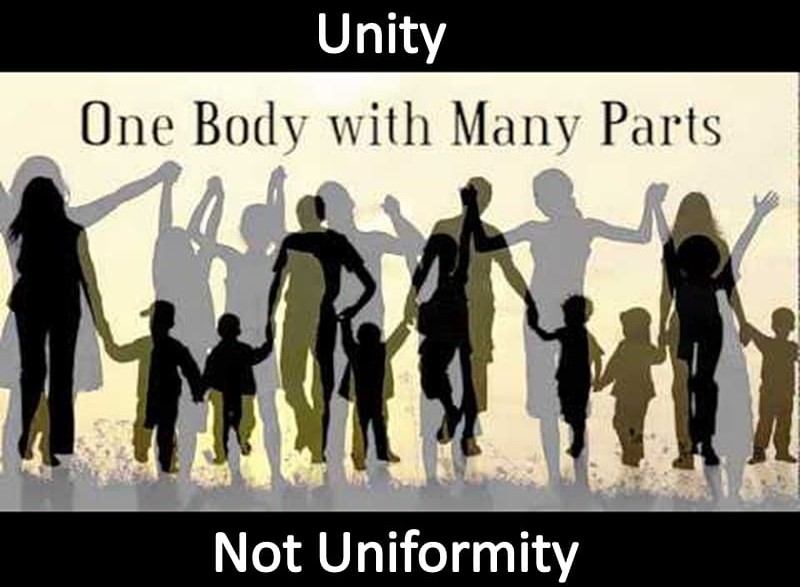
This week we have been celebrating the week of Christian unity, and there could be no more fitting passage than the one we have just heard from chapter 4 of his letter to the Ephesians: these verses are St Paul’s great call for Christian unity.
But, as so often in his writings, what Paul has to say is dense and multi-layered. To tease out some of what he is saying I am going use a method known as ‘exegesis by numbers’ – exegesis simply means the critical interpretation of Scripture. However, I should warn you that ‘exigesis by numbers’ is not a method that is taught in any reputable theological school; it is based on drawing by numbers. I’m sure you know what I mean: those pictures for children with numbered dots. By following the numbers and joining up the dots, a picture emerges; this way, even people with no natural artistic talent, such as myself, can produce – I won’t say create – a passable picture.
We are going to be counting up to five. Are you ready?
One. One baptism. In the decades since the Second World War, the Holy Spirit has drawn divided Christians back to a truth older than our divisions: that we share one baptism into Christ. Through the modern ecumenical movement—shaped by the witness of the World Council of Churches and given decisive affirmation at the Second Vatican Council—the mainline churches have publicly reaffirmed that when water is poured and the Triune name is spoken, it is Christ who acts, not the denomination. In national covenants and global dialogues, Catholics, Orthodox, Anglicans, Lutherans, Reformed, and Methodists have learned to say with humility and joy: we do not rebaptize one another, because God has already claimed us. This shared baptism does not erase our differences, but it grounds our hope, reminding us that before we belong to any church, we belong to Christ—and to one another, as members of his one Body.
Two. Faith. I know – our text says ‘one Lord, one faith, one baptism’. But my point is this: there are two distinct uses of the word faith. On the one hand we say someone is a person of faith when they believe a series of propositions concerning the Christian faith; but a deeper meaning would be about a person who puts their trust in God and his promises. The Greek work, pistis covers both the concepts of faith and trust – and just maybe our Christian unity will be better served if we rely on the latter meaning rather than in discussions that emphasise the former.
Besides, there is another reason for associating the word faith with the number two. Trust is a two-way street: not only must we learn to trust God, but we must become the kind of people whom God can trust. The whole of Christian discipleship lies in that: not only on whether we trust God, but can God trust us?
But it is time to move on. Three. Actually, number three and number five are right next to each other: at the end of this passage tells us that there are five gifts that Christ has given to his church, and in verse 12 Paul tells us that there are three interrelated reasons why he has given them. If I am to keep to my scheme we should begin with the three purposes: 1) is to build up the saints, by which he means all of us 2) for the ministry, 3) which is to build up the body of Christ. And the five gifts or roles are: apostles, prophets, evangelists, pastors and teachers. Without going into too much detail, allow me to make a few suggestions:
- it helps to have a phrase like members of the Body of Christ to define that holy body to which we all belong: terms like the church or ‘catholics’ risk being understood denominationally
- The word for Ministry, here, diakonis, refers to menial service, not to special roles or ordination. Indeed the work of a deacon, was originally to wait at tables. In this sense all members of the Body of Christ, all of us saints, are called to ministry: we all have our roles and our tasks to do.
- Next, and just possibly, the different churches, the different denominations, are better equipped for different roles: thus the emergence of Pentecostal and Charismatic churches since the beginning of the 20th century have reawakened long dormant gifts of prophecy. Our own Anglican tradition has largely been blessed with the gifts of pastors and teacher. Et cetera
- The apostles are the leaders of the church. We should not forget that the original apostles were the same body of people as Our Lord’s disciples, transformed by the Holy Spirit. Especially from Mark’s gospel we get the idea that those original disciples were a rather sorry lot. Like them, we too can accomplish nothing without the work of the Holy Spirit.
But I have left the number four till last. Number four is the list of qualities that Paul suggests are required to build unity: humility and gentleness, patience, bearing with one another in love. Again, allow me to note a few points:
Humility is the original Christian virtue; to put that differently, humility was not regarded as a virtue in the Greco-Roman world, nor perhaps in the contemporary post-Christian culture (one only has to look at some of the national leaders to see this)
Cordiality and patience are relatively straightforward. But perhaps the most interesting and the most crucial of these four virtues is forbearance. This entails cultivating that mutual tolerance without which no group of human beings can live together in peace; it involves a willingness to overlook one another’s faults, real or imagined, which cause us to treat one another with suspicion. Because, alas, most of us begin our ecumenical journey with cultural baggage, if not outright prejudice. To speak of my own experience, when I first went away to boarding school at the age of seven, there were a handful of Roman Catholics in what was otherwise a normal Anglican school. On Sunday mornings they dressed differently from us. When we were marched across town to the Church of St Michael and All Angels, they were driven off in cars somewhere else. Where they went and what they did there we never knew; nor did it ever occur to us to ask. All we knew was that they were different; they weren’t quite like us. It is precisely in such ways that prejudice is born; I put it to you that we are all prejudiced, that we all begin from the beliefs and positions in which the circumstances of birth and upbringing have placed us, and that those circumstances are inevitably positions which are both arbitrary – in the sense that we did not chose them – and biased. So whenever we meet a Christian from another denomination – and please, never, ever be tempted to say from another religion – as convinced members of the Body of Christ our first duty must be to guard against prejudice. Let us say instead, ‘How interesting, here is sister or brother who has taken a different pathway to Our Lord than mine; I wonder what they can teach me’. Let us also remember the virtues of cordiality and humility which St Paul urges upon us.
So what kind of picture has emerged from this exegesis by numbers? I hope it is not a mere scribble. We began by celebrating our shared and common baptism – let us give thanks for this achievement that the ecumenical movement has brought in the lifetimes of many of us. We have talked of faith and how it can mean the need to trust, rather than signing up to a list of propositional statements; the notion of the two-way street reminds us that God is trusting our generation to bring about the great project of ecumenism. And we have talked of God’s gifts to the members of the body of Christ, which are necessary to do this. But perhaps most importantly of all, we have talked of the attitude we need to develop in our ecumenical walk together: may God grant that the Holy Spirit leads us with all humility and gentleness, with patience, to bear with one another in love, in Jesus’s name. Amen