You know what time it is, says Paul in his Letter to the Romans, how it is now the moment for you to wake from sleep. For salvation is nearer to us now than when we became believers…
Let me take two phrases from that verse: you know what time it is; and salvation is near. I want to talk about what time it is, but I’m not talking clock time, not a-quarter-to-eleven-on-a-Sunday-morning-at-the-end-of-November time; I’m talking about liturgical time. And I want to talk about salvation, and how much more it means than that you are going to go to heaven when you die. Although that, if you have been listening to today’s Gospel, is debatable, for, as Jesus says of two men working in the field, and two women grinding corn together: one will be taken and one will be left.
So what time is it? It’s Advent. Advent is both a beginning and a waiting for something to begin. What we are waiting for, of course, is Christmas. But for Christmas to be noticed, for Christmas to work, we have to prepare for it. On the outside, at the obvious level, we have to buy food and presents, and we have to put up tress and decorations, but it is what we do on the inside that really counts. Christmas is about the coming of Christ, the birth of Jesus in Bethlehem, about Emmanuel, God being here and with us in our lives. But just as the three wise men, the three kings, had to go on a journey to discover the Christ-child, we too need to make a pilgrimage of preparation this Advent if we want to see the Christ-child on Christmas day, and not just to decorate a day off with tinsel and too much to eat.
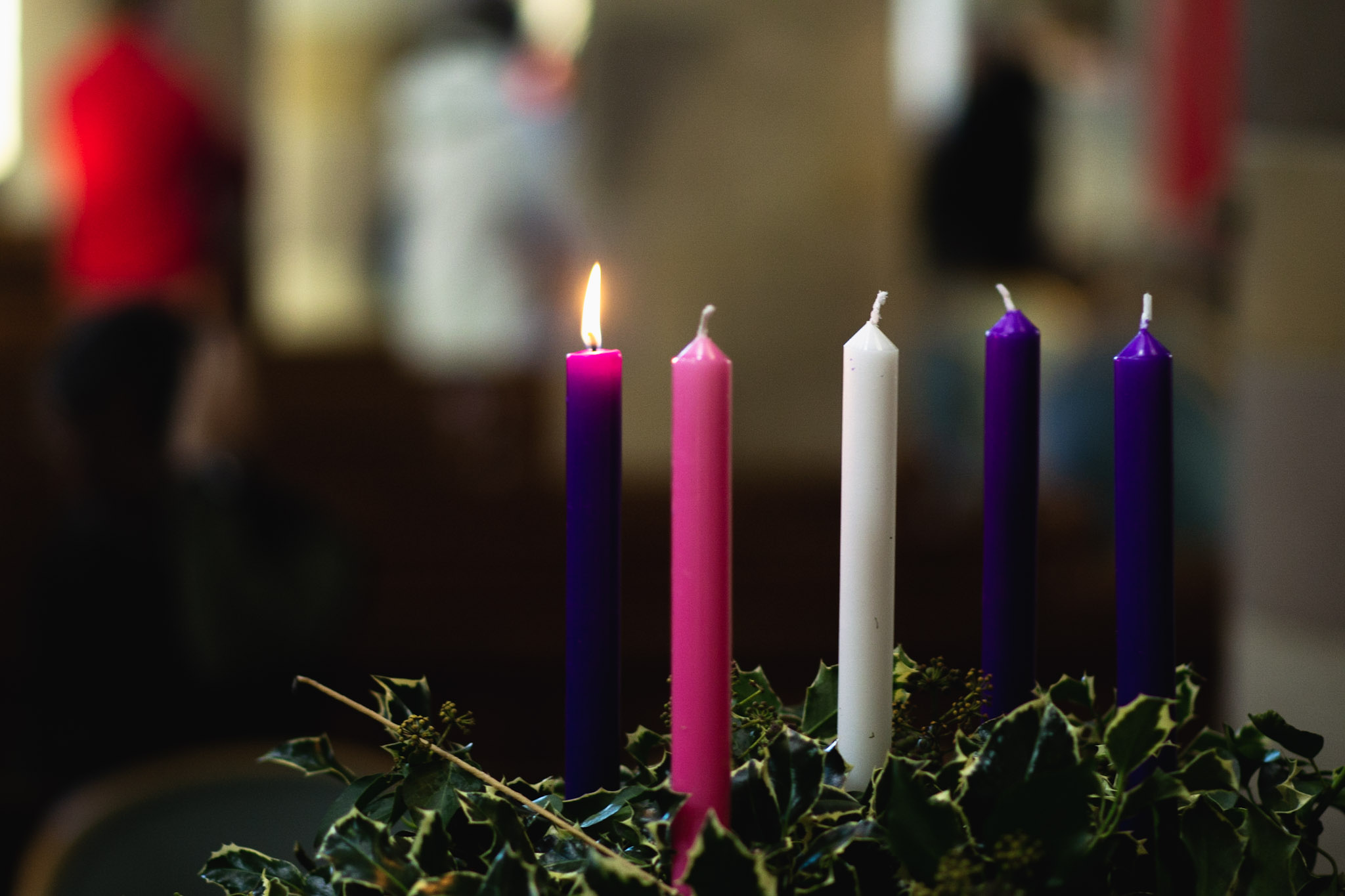
So what does this Advent pilgrimage look like? It should balance solemnity with celebration. It begins in anticipation rather than immediate festivity, and the readings this Sunday emphasize vigilance, readiness, and the promise of God’s kingdom. Remember how, last week, we talked about the Kingdom of God, and I suggested that we each work up a vision of what the Kingdom of God might look like – a vision of a perfected you in a perfected world – well, Advent is when we start preparing ourselves to live in that kingdom: becoming that person and shaping that world. The good news is that we don’t have to do it all by our own efforts: we have a King, a little child, to lead us there. Ultimately, what is expected of us is something huge: as our psalm puts it, we are aiming at Jerusalem, built as a city that is at unity with itself; and that means both the real Jerusalem, the Holy Land of Palestine and Israel, where peace and unity seem so very distant still, but it also means the symbolic Jerusalems, both on the macro scale of human civilisation, and the micro scale of peace and unity in this city, in our communities, and in our homes. Indeed, social justice, and the tradition of Israel’s prophets, and especially John the Baptist, becomes the theme of next Sunday, the second in Advent. The third Sunday takes us through a different landscape – less public and more intimate, less penitent and more joyful, as we begin to contemplate Christ’s imminent arrival: in fact, that is the Sunday when we light the pink candle; it is known as Gaudete Sunday, gaudete being the Latin for ‘rejoice’. And finally, after ‘rejoice’ Sunday comes the last Sunday, just days before Christmas itself, when we focus on the Virgin Mary, on her response to God’s call, and on our own preparedness. To sum up, at the secular New Year on 1st January along with the feasting and fireworks we also make New Year resolutions and try to keep them. The liturgical New Year, the season of Advent, is similar but reverses the emphasis: resolutions, or repentance comes first, and although we have cause to celebrate, we are urged to live honourably and avoid drunkenness and revelling.
St Paul also says, in the passage from the Letter to the Romans we have just heard, that this is a time to wake from sleep, to put away the works of darkness, a time when our salvation is nearer than it is has ever been.
Salvation – we tend to connect it with the idea of getting away from hell and into heaven. But actually, the Greek word soteria means much more than that: it means both deliverance and wholeness: it encompasses notions of freedom, peace, pardon, bodily health, and well-being. It means achieving a state of shalom, both collectively and individually. Time and again those who came in contact with Jesus, those who opened themselves up to him, realised that they had been saved in all these ways: in Jesus they found an acceptance, a deliverance, and a new wholeness. After a word from Jesus, a touch, a look – they knew that they were right with God. That is the deliverance of which Paul is speaking when he says salvation is nearer to us now than when we became believers.
This is why it is appropriate for us today to hold a service of healing. In a minute I am going to ask you to come forward – those of you who want to – and I am going to pray over you and sign your foreheads with holy oil. Let us ask God to mend our brokenness and anoint us with the salve of our salvation. For we are broken in so many ways: some of us are broken in our bodies, some of us are broken in hearts, some of us are broken in our relationships – bring all your brokenness before God, and let Christ’s love touch you. And may the Lord have mercy on us all!
Oh, and to end on two practical notes: If you decide not to come forward, you are invited to sit in silent prayer for those who do, for yourself, or for anyone who comes to mind. For those of you who do come forward, can you simply tell me your name: of course I now know most of you by name, but it will just speed the proceedings up if you can remind me. It is also no bad thing if you speak your own name aloud before God; your name is a little prayer in its own right.