Today’s gospel may have been very short, but it has a lot of punch, it has power!
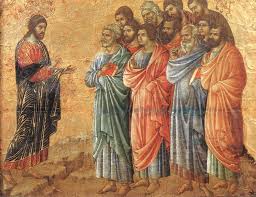
These are the closing words of Matthew’s gospel: after his resurrection Jesus tells his disciples to go to Galilee; they do, and this is a record of what he said to them. It’s a passage known as the Great Commission: it provides the disciples – and by extension all Christians – with their marching orders, it tells the Church, and by extension us, what Jesus expects it to do – and it also provides a summary of the gospel in nugget form. Indeed, it is hard to see how Matthew could have said anything greater, or anything more, in only 40 words.
So having given this passage such a plug it is time to look at it in a little bit more detail. Notice, first of all, that it is sandwich shaped: if the filling of the sandwich consists in Christ’s command to us, these commands are sandwiched in between two statements about himself, that is, the commander. Jesus is, after all, the bread of life, so why not make a sandwich! To give it a rather casual paraphrase, the Great Commission goes like this: ‘I, Jesus, am in complete charge around here! So you people, move on out, disciple, baptize, and teach! I, Jesus, will support you as you do, all of the time – so relax and enjoy!’
Now there have been churches, and times in the church’s history, in which and when Christians have taken this command very seriously, and to great effect; among other things, the Great Commission has provided the incentive and the blueprint for the churches’ phenomenal missionary activity. Notice the power of the word all in this text. There are four of them: Jesus says all authority has been given to him; we are to go out to all nations; we are to do all that he commanded; and he shall be with us for all days.
Incidentally, one of the privileges of serving at a church like this, and of being a member of the congregation here in Genoa, is that we are indeed blessed with a chance to offer Christian witness to all the nations; people from every nation, and every church, and every denomination come in through the doors of our English-speaking church.
But to return to our Gospel passage. I would like to pick out a few phrases and examine them in a little more detail. The first is that astonishing claim that Jesus makes about himself: ‘All authority on heaven and earth has been given to me’ – That is an amazing claim! John’s gospel, you may recall, begins with equally astonishing claims about Jesus: ‘the Word became flesh and lived among us, and we have seen his glory’. John puts this up-front, it’s all in the first chapter. Whereas Matthew puts his revelation at the very end of his gospel, he builds up to his astonishing claim about Christ’s cosmic nature, and he puts the words in Jesus’s own mouth.
However, I would like to focus not on our Lord, but on the disciples – which is to say, on ourselves. There are two fascinating details here. ‘Now the eleven disciples went to Galilee’ – of course! Because Judas Iscariot is no longer with them. But doesn’t that eleven rather limp along? Eleven just doesn’t sound like a Biblical number. And yet there is something about the nature of the church that is eleven-ish: it is imperfect, incomplete, & fallible.
Even more interesting is the next sentence: ‘When they saw him, they worshiped him; though some doubted.’ Though some doubted? These were the closest disciples who had been together in the upper room on Easter day, when the risen Lord materialised among them; the disciples who had just walked a hundred miles from Jerusalem to Galilee to keep an appointment with a dead man. Surely that takes faith? And yet Matthew tells us that even now some of them still doubted. While this phrase may be puzzling with regard to these eleven disciples at that moment, it is very encouraging for us. Don’t we have our doubts about this Galilean teacher who not only rose from the dead, but claimed to have been given all authority in heaven and on earth? Of course we do. This is also a profound insight into faith. Christian faith is bipolar: we worship and we doubt, we adore and we wonder, we trust and we question. Yet Jesus appears to overlook the problem: in the Great Commission he seems to be saying that we will win the war with doubt simply by obeying his mission command. This reminds us of Albert Schweitzer’s famous saying: “Follow him and you will know him.” Doubt and worship can and do co-exist – remember those words about only having faith the size of a mustard seed? Jesus seems to be telling us to ‘expect great things even with our very ordinary faith’.
Indeed much of the Christian life is concerned with very ordinary things: we are not told to go out and do miracles, we are not expected to wear a halo. But we are expected to share our faith, to follow Christ’s commands and to look to him not just for support but for empowerment.
To make one final point: today is Trinity Sunday, yet I haven’t said a word about it. Of the many baffling things that you may have heard said about the supposedly complex doctrine of the Holy Trinity is that isn’t in the Bible, that it was added later, even centuries later, by theologians. Well that’s not true at all! It is clearly there in both of today’s readings: in Matthew’s Great Commission Jesus himself tells his disciples to baptize the nations in the name of the Father, of the Son, and of the Holy Spirit. And Paul ends his letter to the Corinthians with a thoroughly trinitarian blessing, exactly the same blessing with which we end our Eucharistic celebration Sunday after Sunday: The grace of the Lord Jesus Christ, the love of God, and the communion of the Holy Spirit be with all of you.